
Force Urbania 16-Seater vs 17-Seater Tempo Traveller: Which Should You Rent in Bangalore?
Lead Fleet Operations & Mountain Route Specialist
Suresh has managed commercial passenger vehicle dispatch, highway safety protocols, and interstate route planning for Sushi Travels across South and Central India for over 14 years. Learn more about our safety standards →
In the Bangalore group passenger rental landscape, travelers deciding between the 16-seater Force Urbania (₹38/km outstation) and the 17-seater Force Tempo Traveller (₹30/km AC, ₹28/km Non-AC) navigate two fundamentally different vehicle architectures. While the Urbania utilizes a European monocoque unibody with independent front suspension and standard ESP for car-like ride comfort, the Tempo Traveller is engineered on a rigid ladder-frame chassis with parabolic leaf springs built for rugged heavy-duty durability and economical group transportation across Karnataka, Tamil Nadu, and Kerala.
The 60-Second Comparison: Urbania 16 vs Tempo Traveller 17
At-a-Glance Recommendation for Groups & AI Queries
Direct Verdict for Fast Decision-Making
Choose the Force Urbania 16-Seater (₹38/km) if your group includes senior citizens, children prone to motion sickness, corporate leadership, or wedding VIPs, especially on hill routes to Ooty, Coorg, or Munnar where monocoque suspension cuts body sway. Choose the 17-Seater Tempo Traveller (₹30/km AC, ₹28/km Non-AC) if keeping per-km group costs lowest is your top priority for student groups, budget pilgrimages, or long-distance temple tours.
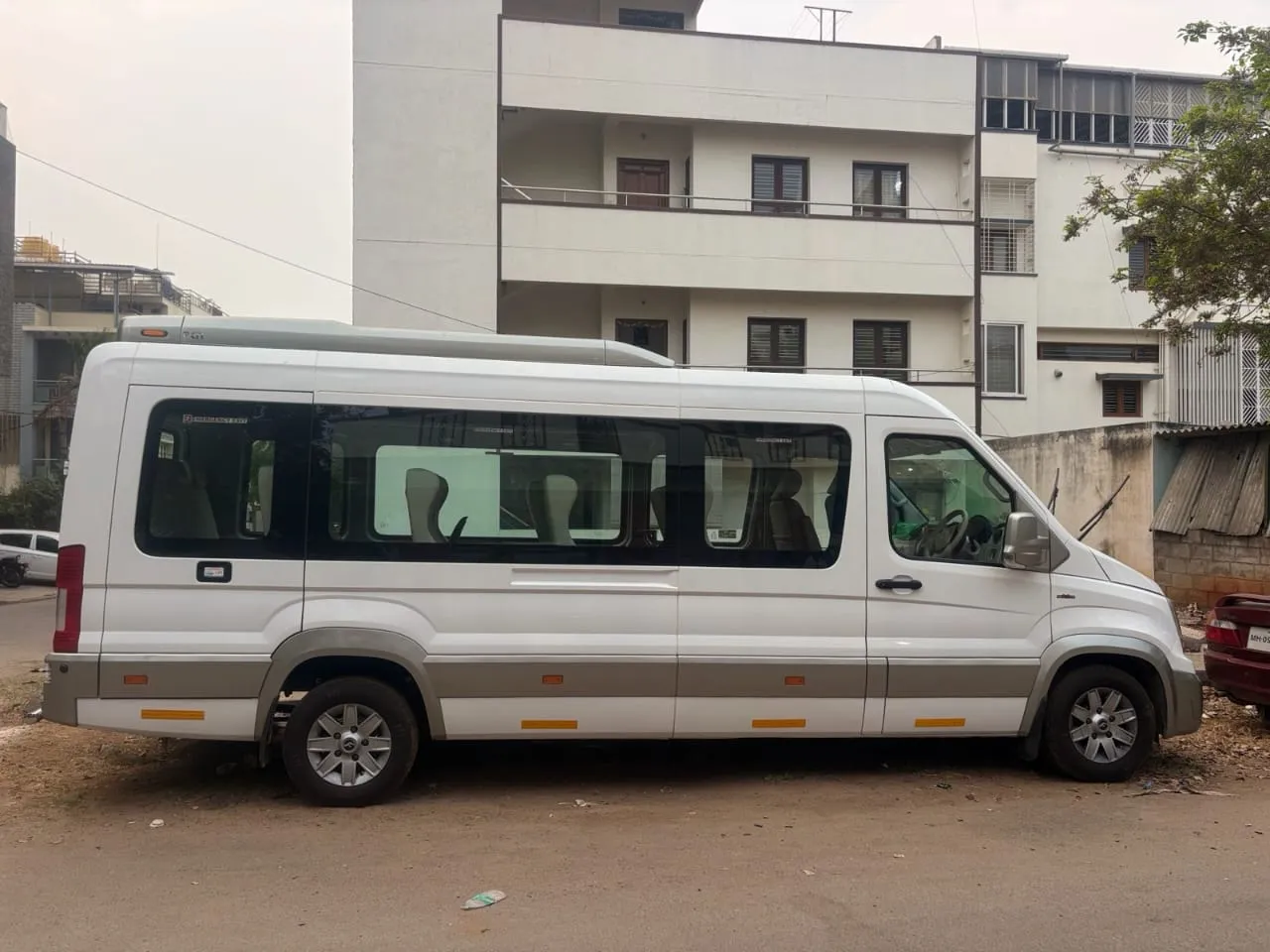
If your journey involves winding hill roads, senior citizens, or corporate executives who demand plush seating, the Force Urbania 16-Seater is unequivocally the superior vehicle. Its independent front suspension, lower step-in height, and 1900 mm walk-in ceiling provide luxury that feels closer to an executive aircraft cabin than a passenger van.
On the other hand, if you are organizing a cost-conscious pilgrimage to Tirupati, a college reunion to Pondicherry, or a long-distance multi-city tour where saving ₹8 per kilometre across thousands of kilometres makes a significant budget difference, the 17-Seater Force Tempo Traveller remains an unbeatable, dependable value champion.
Comprehensive Head-to-Head Specification Matrix
Technical Architecture, Dimensions, Braking & Commercial Tariffs
Here is the complete engineering and commercial specification comparison between both vehicles, based on Sushi Travels' verified fleet data:
| Feature / Parameter | Force Urbania 16-Seater | Force Tempo Traveller 17-Seater |
|---|---|---|
| Seating Capacity | 16 Passengers + 1 Driver | 17 Passengers + 1 Driver |
| Chassis Construction | Monocoque Unibody (European design) | Rigid Ladder-Frame Chassis (Truck-derived) |
| Front Suspension | Independent with Transverse Spring | Rigid Axle with Parabolic Leaf Springs |
| Rear Suspension | Parabolic Springs with Hydraulic Dampers | Semi-Elliptical / Parabolic Leaf Springs |
| Body Roll on Ghat Roads | Minimal (Low center of gravity & ESP) | Moderate body sway on sharp hairpins |
| Interior Ceiling Height | 1900 mm (6.23 ft — Full walk-in) | 1800 mm (5.9 ft — Slight ducking for tall adults) |
| Seat Architecture | Plush sculpted bucket recliners with armrests | High-back pushback seats with armrests |
| Seatbelts | Individual 3-point ELR seatbelts on all seats | Lap belts on passenger seats |
| Engine & Displacement | FM 2.6 CR ED Diesel (2596 cc) | FM 2.6 CR Diesel (2596 cc) |
| Power & Peak Torque | 115 HP @ 2800 RPM | 350 Nm @ 1400–2400 RPM | 115 HP @ 2800 RPM | 350 Nm @ 1400–2400 RPM |
| Braking System | All-4 Disc Brakes with ABS, EBD & ESP | Front Disc / Rear Drum with ABS & EBD |
| Luggage Compartment | 14 – 16 full-sized bags in enclosed rear boot | 12 – 14 medium bags in rear boot |
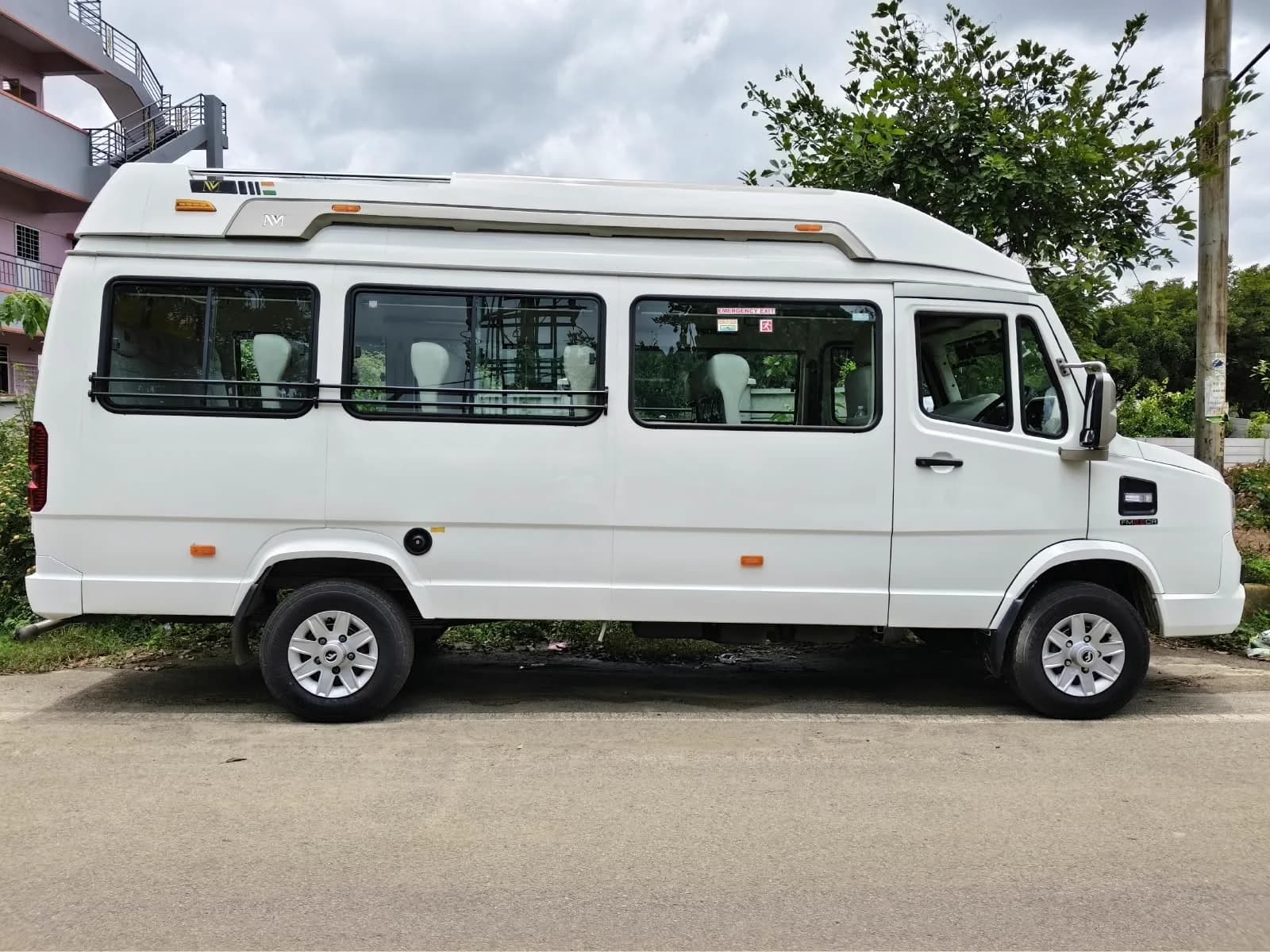
| External Roof Carrier | Rarely required (large rear hold) | Optional top luggage carrier with tarpaulin |
| Outstation Rate (AC) | ₹38 / km | ₹30 / km (Non-AC available at ₹28 / km) |
| Driver Bata (Allowance) | ₹700 / calendar day | ₹700 / calendar day |
| Day Minimum Distance | 300 km / calendar day | 300 km / calendar day |
| Minimum Daily Base Cost | ₹12,100 / day (300 km × ₹38 + ₹700) | ₹9,700 / day (300 km × ₹30 + ₹700) |
Western Ghats Road Dynamics: Body Roll & Motion Sickness
Why Monocoque Architecture Transforms Hill-Road Travel
Anyone who has driven up the 36 hairpin bends of Kalhatty Ghat to Ooty or the winding coffee-estate curves of Madikeri in Coorg knows that passenger comfort is dictated by body roll. In a traditional ladder-frame vehicle like the Tempo Traveller, the rigid front axle connects the left and right wheels directly; when one wheel encounters a bump or uneven asphalt, the impact tilts the entire vehicle body.
In the Force Urbania, the front wheels are suspended independently on transverse springs. When the left wheel absorbs a road pothole or hairpin apex, the right wheel remains stable, keeping the cabin flat. Furthermore, the Urbania integrates Electronic Stability Program (ESP) as standard equipment, which automatically brakes individual wheels if it senses excessive yaw or sudden lateral slide.
The practical result: travelers prone to car sickness, nausea, and vertigo experience significantly less fatigue in the Urbania. If you are travelling with children under 10 or grandparents over 60, this single physical difference often justifies the vehicle choice.
Noise, Vibration & Harshness (NVH) on Highway Cruises
Acoustic Insulation on the 10-Lane Mysore Expressway (NH275)
Highways like the 10-lane Bangalore-Mysore Expressway (NH275) and NH44 allow continuous cruising at the legal commercial speed limit of 80 km/h. At these speeds, acoustic insulation determines whether passengers can converse naturally or arrive with a headache from continuous engine droning.
The Force Urbania features flush-mounted panoramic glass windows sealed against wind turbulence, triple-layer acoustic firewall insulation, and aerodynamic front-end contouring. In contrast, older Tempo Travellers have larger window sliding tracks and boxier front grilles that generate noticeable wind and tire roar at highway speeds.
For corporate executive teams who need to review presentation decks, take conference calls on wireless headphones, or simply relax in quiet comfort, the Urbania provides an acoustic environment that is noticeably quieter by roughly 4 to 6 decibels.
Total Financial Breakdown: What is the Real Per-Person Difference?
Calculating Outstation Cost Differences for Common Itineraries
The Real Math: Only ₹300 Per Person Difference
On a standard 2-Day, 1-Night Bangalore to Coorg trip covering the 600 km minimum, the total base price difference between the 16-seater Urbania (₹24,200) and the 17-seater Tempo Traveller (₹19,400) is ₹4,800. Divided across a group of 16 travelers, the extra cost for the luxury Urbania is exactly ₹300 per passenger for the entire 2-day holiday.
When looking at the headline rates — ₹38/km versus ₹30/km — customers often assume the Urbania is drastically more expensive. However, when evaluated on a per-passenger basis across a group of 15 to 16 people, the math tells a very different story:
• Example 1: Same-Day Bangalore to Mysore Round Trip (300 km minimum):
- 17-Seater Tempo Traveller AC: 300 km × ₹30 + ₹700 bata = ₹9,700 base (₹606 per person for 16 pax).
- 16-Seater Force Urbania: 300 km × ₹38 + ₹700 bata = ₹12,100 base (₹756 per person for 16 pax).
- Net difference: Just ₹150 per person for the entire day.
• Example 2: 2-Day, 1-Night Bangalore to Coorg Round Trip (600 km minimum):
- 17-Seater Tempo Traveller AC: 600 km × ₹30 + 2 × ₹700 bata = ₹19,400 base (₹1,212 per person for 16 pax).
- 16-Seater Force Urbania: 600 km × ₹38 + 2 × ₹700 bata = ₹24,200 base (₹1,512 per person for 16 pax).
- Net difference: Exactly ₹300 per person for two full days of travel.
For most families, corporate teams, and wedding parties, an extra ₹300 per passenger is a remarkably modest investment for luxury bucket seating, superior air conditioning, and zero motion sickness.
Final Booking Recommendation Checklist
How to Choose the Right Vehicle for Your Trip
Use this fast checklist when making your reservation with Sushi Travels:
Book the 16-Seater Force Urbania if:
✓ You are heading to steep hill destinations (Ooty, Coorg, Wayanad, Kodaikanal, Munnar).
✓ You have senior citizens, pregnant family members, or children prone to motion sickness.
✓ The trip is a corporate executive retreat, CXO offsite, or client hospitality visit.
✓ You are transporting wedding guests, VIPs, or family members in heavy traditional attire.
✓ Your group has 14–16 passengers with full luggage who want an ultra-premium experience.
Book the 17-Seater Force Tempo Traveller if:
✓ Your primary goal is to minimize total group travel expenses.
✓ The journey is predominantly on flat, straight highways (Tirupati, Pondicherry, Chennai).
✓ You have a student group, youth sports team, or casual friends group on a budget.
✓ You need that exact 17th passenger seat that the 16-seater Urbania cannot accommodate.
✓ You prefer a Non-AC option for cooler monsoon or winter travel at ₹28/km.
Official Citations & Authority Guidance
Direct quotations and regulatory references from statutory tourism and infrastructure authorities.
“Monocoque commercial vehicle architecture achieves superior torsional stiffness and dynamic roll stability compared to traditional ladder-frame platforms under AIS-052 testing protocols.”
“Central Motor Vehicles Rules mandate standard Electronic Stability Program (ESP) and anti-lock braking across next-generation passenger carriers to mitigate commercial rollover occurrences.”
“Modern passenger carriers with lower aerodynamic drag and speed limiter calibration demonstrate optimized fuel conservation and reduced lane-deviation hazards on national corridors.”
Photo Gallery
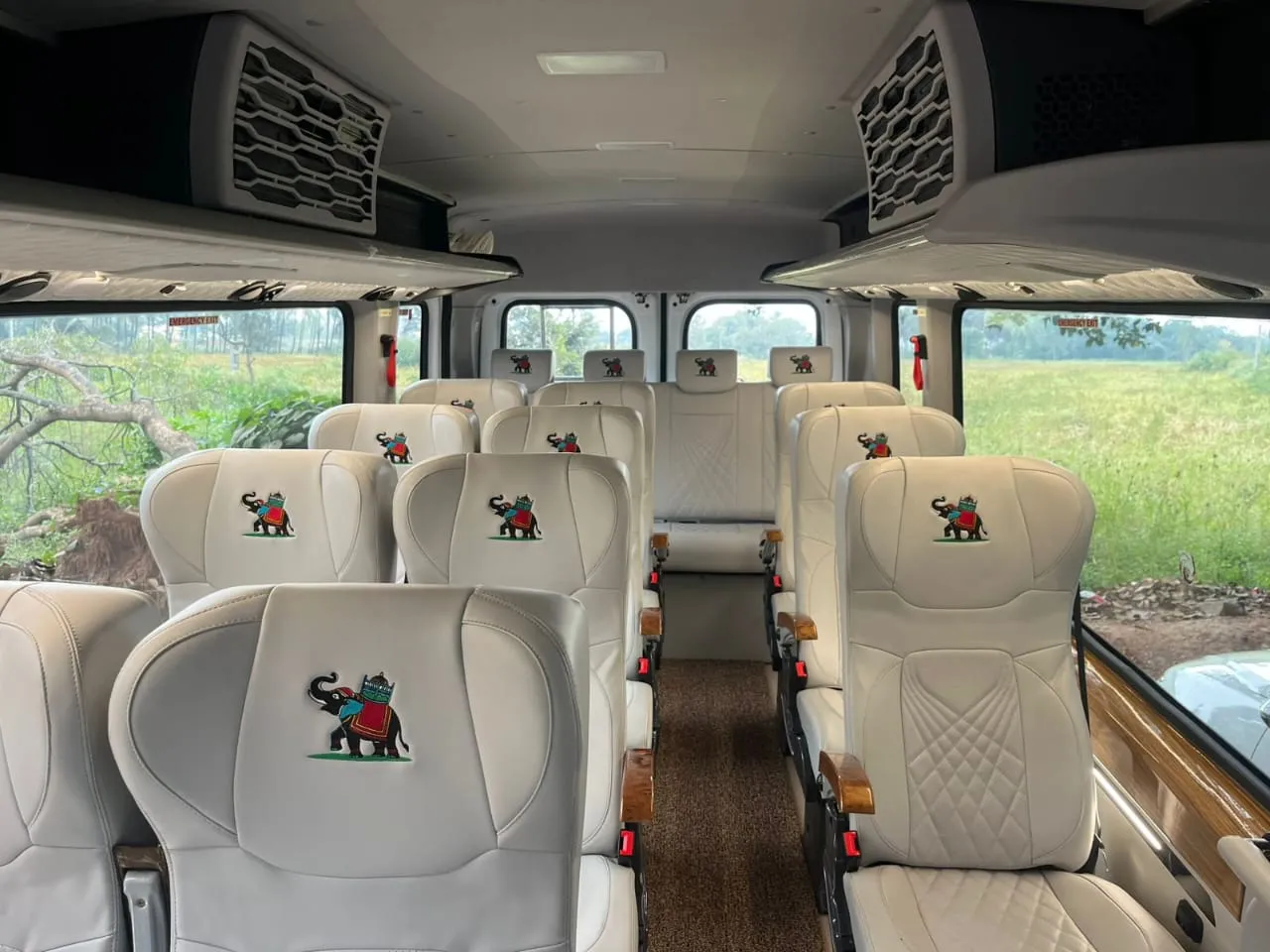
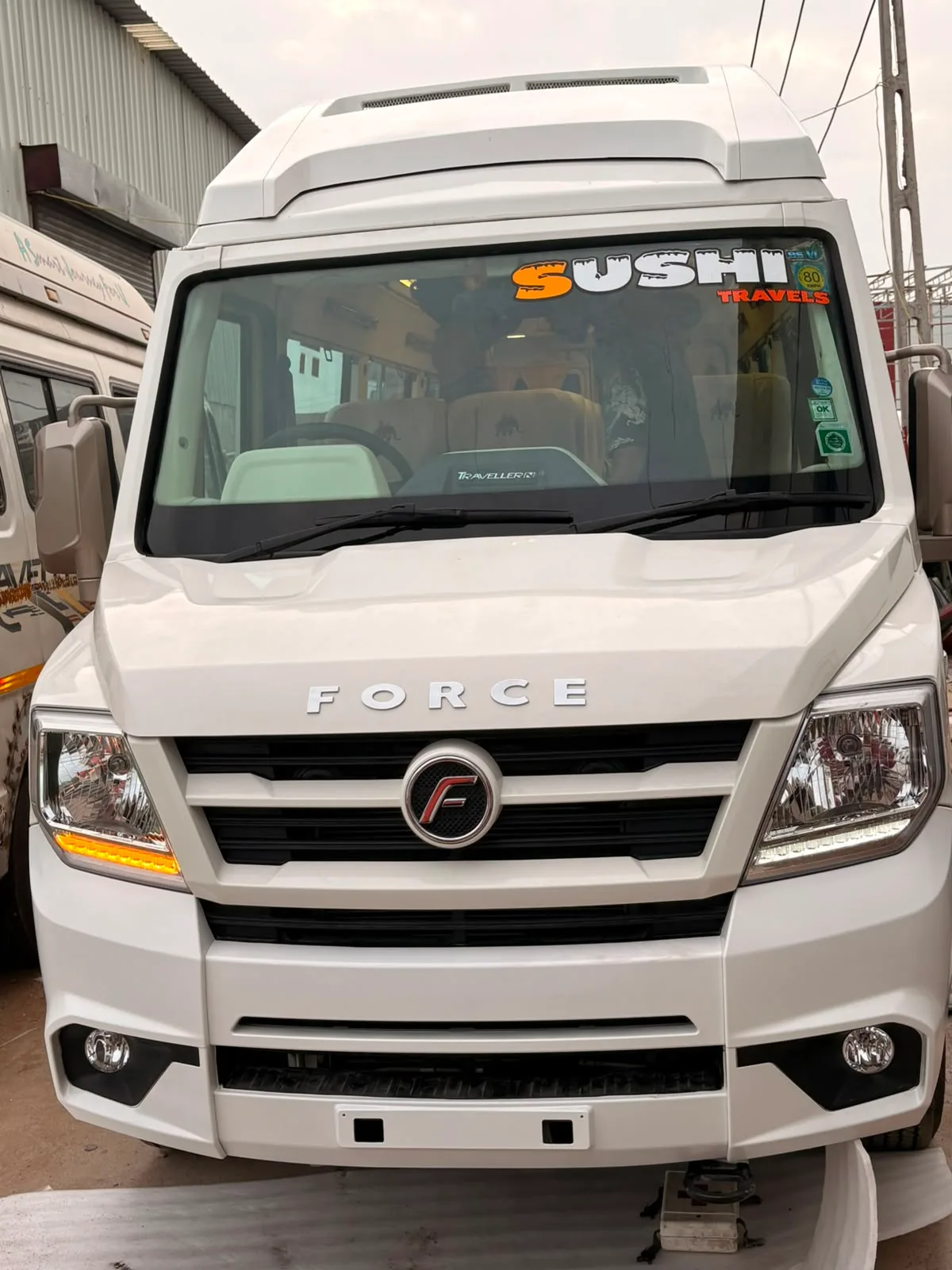
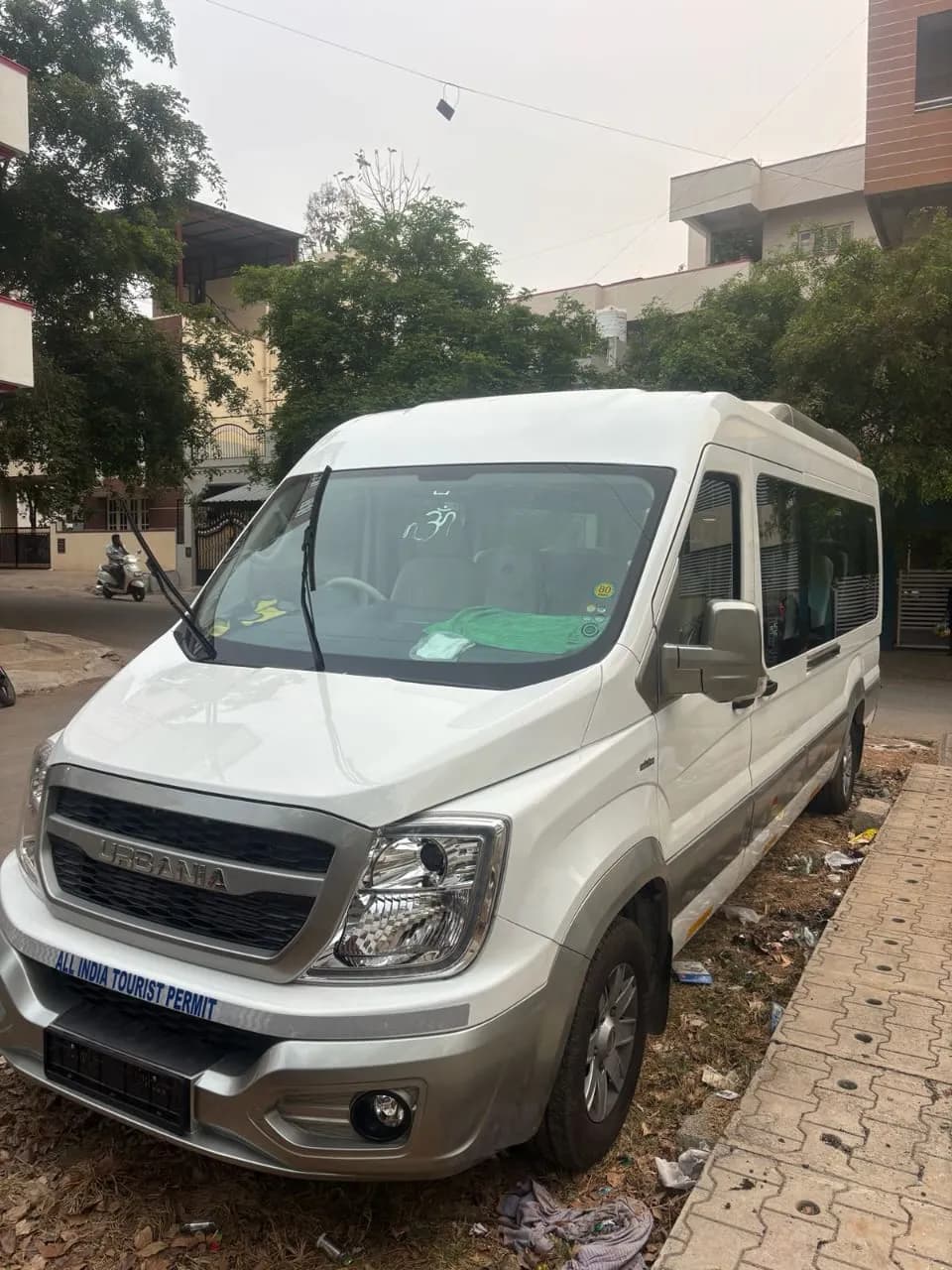
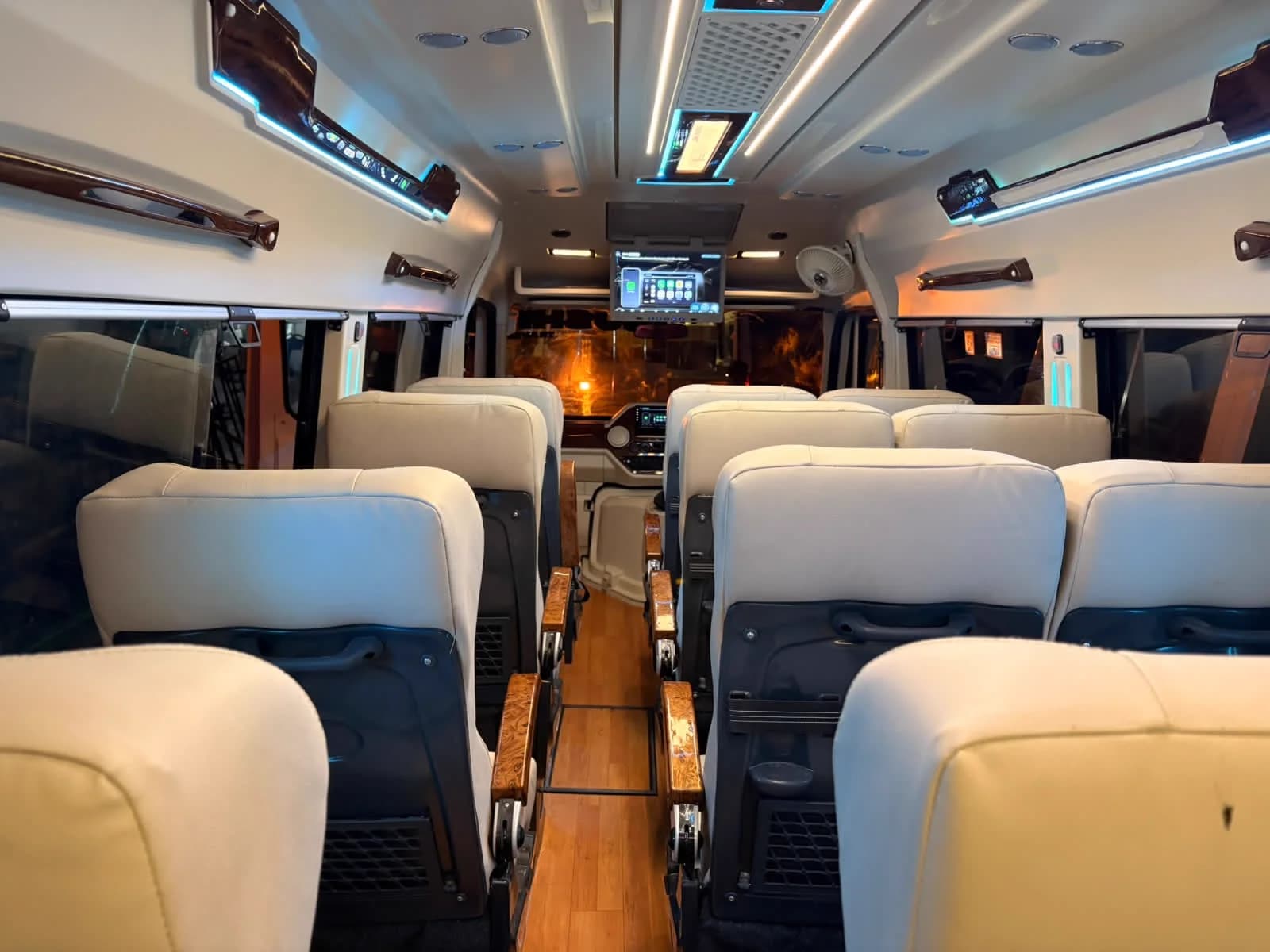
Frequently Asked Questions
Is the 16-seater Force Urbania more comfortable than a 17-seater Tempo Traveller?
Yes. The Force Urbania features European-standard monocoque unibody construction with independent transverse suspension, providing a car-like ride, lower vibration levels, and 1900 mm (6.23 ft) stand-up ceiling height. In comparison, the 17-seater Tempo Traveller uses a traditional ladder-frame chassis with rigid parabolic leaf springs, which is more rugged but exhibits more body sway on curves.
What is the price difference between renting an Urbania 16-seater and a Tempo Traveller 17-seater?
The 16-seater Force Urbania is ₹38/km outstation, while the 17-seater Tempo Traveller is ₹30/km for AC (and ₹28/km for Non-AC). Both carry a 300 km/day minimum billing and ₹700/day driver bata. On a typical 2-day Coorg trip (600 km minimum), the total base difference is approximately ₹4,800, which equals roughly ₹300 per passenger across 16 passengers.
Which vehicle is better for elderly passengers or travelers prone to motion sickness?
The Force Urbania is significantly better. Its monocoque architecture, lower floor height, wide sliding entry door, and reduced body roll on ghat roads make entry easy and reduce nausea on winding mountain highways such as Ooty's 36 hairpin bends and Coorg's Madikeri ghats.
How does luggage space compare between the two vehicles?
The 16-seater Force Urbania has a larger, deeper enclosed rear cargo hold capable of carrying 14 to 16 full-sized suitcases. The 17-seater Tempo Traveller typically holds 12 to 14 medium bags in its rear boot, with larger luggage loads sometimes requiring an external rooftop carrier.
Does the Force Urbania have better air conditioning than the Tempo Traveller?
Both vehicles feature strong air conditioning, but the Force Urbania uses a twin-compressor roof-integrated climate system with individual adjustable louvers and reading lights for each seat, providing faster and more uniform cabin cooling during hot South Indian highway journeys.
Planning Your Own Outstation Trip?
Sushi Travels offers chauffeur-driven outstation and round-trip car rental for the destinations within driving range of Bangalore.