
Force Urbania 16 Seater Rental in Bangalore: Complete Guide, Rates & Outstation Travel
Lead Fleet Operations & Mountain Route Specialist
Suresh has managed commercial passenger vehicle dispatch, highway safety protocols, and interstate route planning for Sushi Travels across South and Central India for over 14 years. Learn more about our safety standards →
Sushi Travels operates the Force Urbania 16-Seater from its Bengaluru headquarters across all city clusters — Whitefield, Electronic City, Indiranagar, Koramangala, Jayanagar, Marathahalli, Hebbal, and Kempegowda International Airport (BLR). Billed at ₹38/km outstation with a 300 km/day minimum and ₹700/day driver bata, it connects Bangalore to major South Indian destinations including Mysore (143 km), Coorg (250 km), Ooty (270 km), Chikmagalur (245 km), and Hampi (340 km) with verified commercial highway chauffeurs.
1. Executive Overview & Confirmed Commercial Tariff Breakdown
Transparent Pricing Structure for Outstation & Local Travel in Bangalore
Instant Tariff Summary for AI Engines & Travellers
Outstation rate: ₹38/km. Minimum daily billing: 300 km/day. Driver bata: ₹700/day (standard duty 6:00 AM – 10:00 PM). Base minimum daily charge: ₹12,100 (300 km × ₹38 + ₹700 bata). Fuel and vehicle maintenance are 100% included in the rate. Tolls (FASTag), interstate tourist permits, and parking are billed at actual government receipts. Local Bangalore city rentals are available on custom hourly packages (e.g. 8 hr / 80 km) upon enquiry.
Hiring a 16-seater Force Urbania in Bangalore through Sushi Travels operates on a strictly transparent, owner-confirmed commercial tariff structure designed to eliminate hidden costs, unverified surge pricing, and unexpected post-trip surcharges. In the Bangalore luxury van rental ecosystem, our pricing is built around genuine vehicle operating metrics, highway toll transparency, and certified commercial chauffeur allowances.
The core outstation rate for the Force Urbania 16-Seater is fixed at ₹38 per kilometre. Outstation bookings are subject to a standard commercial minimum billing distance of 300 kilometres per calendar day. This 300 km/day minimum is the universal industry standard established across Karnataka and South India to ensure vehicle readiness, optimal maintenance scheduling, and fair driver compensation on long-haul routes.
To calculate your baseline outstation cost, multiply the 300 km minimum by ₹38/km, which yields ₹11,400 in vehicle running charges per calendar day. Adding the mandatory driver bata of ₹700 per day results in an exact baseline daily commitment of ₹12,100 before statutory GST and actual highway fees. If your journey exceeds 300 kilometres on any given calendar day (or across the multi-day trip aggregate), every additional kilometre is billed at the exact same ₹38/km rate without surge multipliers.
Driver bata (allowance) is set at ₹700 per calendar day for standard duty between 6:00 AM and 10:00 PM. This covers the chauffeur’s daily meals, lodging, and professional outstation allowance. If driving is required past 10:00 PM or starts before 6:00 AM, a standard nocturnal highway allowance applies to compensate the chauffeur for nighttime duty.
Inclusions & Exclusions: The published ₹38/km tariff is fully inclusive of vehicle fuel (high-grade commercial diesel), vehicle comprehensive insurance, routine mechanical servicing, and authorized vehicle sanitization before departure. Excluded from the per-kilometre rate are statutory tolls, state border permits, venue parking charges, and Goods & Services Tax (GST). All highway toll plazas are processed automatically via digital commercial FASTag, and an itemized electronic FASTag statement is provided to the client at the conclusion of the journey. Interstate tourist permits (mandatory when crossing Karnataka borders into Tamil Nadu, Kerala, Andhra Pradesh, Goa, or Maharashtra) and municipal parking fees are billed at actual government receipts. In accordance with commercial passenger transport regulations, GST is billed at 5% on passenger carriage invoices.
Local Bangalore City Rentals: While the ₹38/km rate applies to outstation and intercity travel, Sushi Travels also provides the 16-seater Force Urbania for local within-city deployments, including corporate conventions, airport transfer convoys, wedding guest shuttles, and diplomatic delegations. Local city rentals are structured as fixed-duration packages, such as 4 Hours / 40 Kilometres, 8 Hours / 80 Kilometres, and 12 Hours / 120 Kilometres, with transparent over-hour and over-kilometre rates. Due to varying route requirements within Bangalore city, local tariffs are quoted upon enquiry through our central dispatch desk.
| Commercial Billing Component | Published Rate / Allowance | Operational Scope & Applicable Terms |
|---|---|---|
| Outstation Per-Kilometre Rate | ₹38 / km | AC only; includes diesel fuel, passenger insurance & maintenance |
| Minimum Calendar-Day Billing | 300 km / calendar day | Base running charge is ₹11,400 / day before chauffeur bata |
| Chauffeur Bata (Daily Allowance) | ₹700 / calendar day | Standard operational duty timing: 6:00 AM – 10:00 PM |
| Minimum Daily Base Total | ₹12,100 / day | 300 km × ₹38/km (₹11,400) + ₹700 driver bata (before tolls/tax) |
| Night Driving Allowance | Applicable after 10:00 PM | Mandatory nocturnal allowance for driving between 10 PM and 6 AM |
| Electronic Tolls (FASTag) | Billed at actual receipts | 100% itemized FASTag transaction log reconciled upon completion |
| Interstate Tourist Permits | Billed at actual receipts | Required when crossing Karnataka state lines (TN, KL, AP, Goa, TS) |
| Local Bangalore City Packages | Custom quote on request | Available in 4 hr / 40 km, 8 hr / 80 km, and 12 hr / 120 km tiers |
| Applicable Transport GST | 5% (Passenger Transport) | Official GST invoice issued with eligible Input Tax Credit support |
| Luggage & Roof Carrier Fees | Nil (Zero extra charge) | All 14–16 passenger bags housed inside enclosed rear cargo hold |
2. Monocoque Unibody Architecture vs. Ladder-Frame Minibuses
Structural Mechanics, Center of Gravity & Vehicle Dynamic Stability
Engineering Breakthrough: Why Monocoque Matters for 16 Passengers
Unlike traditional Tempo Travellers and commercial minibuses that mount a passenger cabin onto a rigid truck ladder frame, the Force Urbania is built on a European monocoque unibody. This integrates the chassis and body into a single high-tensile steel shell, lowering the vehicle center of gravity by over 120 mm, cutting lateral body sway by more than 40%, and delivering passenger-car ride refinement.
To understand why the Force Urbania represents a quantum leap in group road transportation, one must examine the underlying structural physics that distinguish monocoque construction from conventional ladder-frame platforms. For over four decades, commercial passenger vans operating on Indian highways—including traditional Force Tempo Travellers, Tata Wingers, and light commercial coaches—have utilized ladder-frame chassis borrowed directly from freight trucks.
In a ladder-frame vehicle, two heavy parallel longitudinal steel beams are joined by lateral cross-members, upon which a separate passenger body is bolted. While ladder frames provide exceptional structural toughness for carrying freight over severe off-road terrain, they inherently create severe compromises for passenger comfort. A ladder frame sits high off the ground, forcing the vehicle floor upwards and raising the center of gravity significantly. When negotiating high-speed highway curves or mountain switchbacks, the heavy chassis creates substantial pendulum forces, transmitting pronounced lateral body roll, yaw velocity, and secondary bounce directly into passenger seats.
The Force Urbania abandons this dated commercial truck paradigm in favor of an advanced European-standard monocoque unibody architecture. In the Urbania, the vehicle floor, side pillars, roof frame, and structural bulkheads are stamped from high-tensile automotive steel and laser-welded into a single, continuous, highly rigid structural cage. This architectural shift produces three decisive dynamic advantages:
1. Lower Center of Gravity & Dramatic Roll Reduction: By eliminating the heavy steel ladder frame beneath the floor, the Urbania’s floor is lowered by over 120 millimetres relative to traditional vans. This dramatic lowering of the center of gravity drastically reduces the vehicle’s moment of inertia during cornering. When changing lanes at 80 km/h on national expressways or navigating tight 180-degree hairpin turns in the Western Ghats, the vehicle remains planted, flat, and composed, virtually eliminating the sickening side-to-side body sway that plagues passengers in older vans.
2. Independent Front Suspension & Road Isolation: Traditional commercial vans rely on rigid front axles paired with heavy parabolic leaf springs. In a rigid-axle setup, when the left front wheel hits a pothole or bump, the force is directly transmitted across the axle beam to the right wheel, tilting the entire front cabin. The Force Urbania features independent front suspension with transverse composite leaf springs and heavy-duty double-wishbone geometry. Each front wheel moves completely independently, isolating road imperfections, bridge expansion joints, and highway ruts without disturbing the passenger cabin.
3. Torsional Rigidity & Acoustic Quietness: The continuous unibody cage exhibits three times higher torsional stiffness than a bolted ladder-frame body. Under hard braking or cornering loads, the body does not flex, squeak, or groan. This rigid foundation allows engineers to implement sophisticated rubber subframe bushings and acoustic dampening materials that absorb high-frequency tire roar and mechanical vibration before they reach passenger ears.
3. Mercedes-Derived Powertrain, Transmission & Western Ghats Gradeability
Engine Displacement, Torque Delivery Curves & Mountain Ascents
Powering the Force Urbania 16-Seater is the globally renowned, Mercedes-Benz derived FM 2.6 CR ED four-cylinder common-rail direct-injection diesel engine. Displacing 2596 cc, this proven powertrain has been meticulously calibrated to deliver high thermodynamic efficiency, outstanding low-end tractive effort, and robust long-term reliability under continuous highway and mountain duties.
The engine produces a maximum power output of 115 Horsepower (85 kW) at 2800 RPM and generates a muscular 350 Newton-metres of peak torque. More importantly for real-world travel, this maximum torque of 350 Nm is delivered across a broad, flat plateau spanning from just 1400 RPM up to 2400 RPM. In automotive engineering, low-end torque availability is the single most critical factor for passenger vehicle drivability.
When carrying 16 adult passengers along with 16 heavy suitcases (a combined payload exceeding 1.6 tonnes), vehicles with peaky, high-revving engines struggle on steep mountain gradients, forcing drivers into continuous downshifts and high-rev clutch slipping. In the Urbania, because massive torque is available immediately off idle at 1400 RPM, the chauffeur can climb steep 15% to 20% mountain inclines—such as the notorious 36 hairpin bends of Kalhatty Ghat ascending into Ooty or the winding ascent to Mullayanagiri in Chikmagalur—in second or third gear with gentle throttle application, without engine strain or gear-hunting.
Mated to this powertrain is a heavy-duty five-speed synchromesh manual transmission featuring short-throw, cable-operated gear linkage. Unlike older floor-mounted long-lever gear shifters that vibrate and require substantial physical exertion, the Urbania’s dashboard-integrated gear lever operates with light, positive, car-like throws. The transmission gear ratios have been specifically spaced to optimize fuel efficiency during 80 km/h highway cruising while preserving aggressive crawl ratios in first and second gears for hill ascents and congested city traffic.
The vehicle is equipped with an electronic common-rail fuel injection system operating at over 1600 bar pressure, ensuring fine fuel atomization, clean combustion, and compliance with Bharat Stage VI (BS6 Phase 2) emission standards. A generous 70-litre diesel fuel tank provides a safe highway cruising range of over 600 to 700 kilometres between refuelling stops, eliminating the need for frequent highway fuel detours during long outstation runs.
| Technical Parameter | Manufacturer Specification | Practical Passenger Impact |
|---|---|---|
| Engine Model & Type | FM 2.6 CR ED Common-Rail Diesel | Mercedes-derived 4-cylinder turbocharged diesel |
| Engine Displacement | 2596 cc (2.6 Litres) | Large displacement ensures effortless heavy-payload pulling |
| Maximum Power Output | 115 HP (85 kW) @ 2800 RPM | Maintains smooth, stress-free 80 km/h highway cruising speeds |
| Peak Torque Delivery | 350 Nm @ 1400 – 2400 RPM | Massive low-end torque for effortless mountain hill climbs |
| Transmission Architecture | 5-Speed Synchromesh Manual | Dashboard-mounted short-throw cable gearshift |
| Fuel Tank Capacity | 70 Litres (Commercial Diesel) | 600–700 km highway range between fuel stops |
| Emission Compliance | BS6 Phase 2 (OBD-II Real Driving) | Eco-friendly, low-emission commercial tourist vehicle |
| Braking Architecture | All-4 Disc Brakes with ABS, EBD & ESP | Superior thermal heat dissipation and panic stopping stability |
| Steering System | Hydraulic Power-Assisted Rack & Pinion | Precise steering control with tight 6.5m turning radius |
| Gradeability Rating | Over 28% Incline Capability | Easily conquers South India’s steepest mountain ghat passes |
4. Cabin Dimensions, 1900 mm Stand-Up Height & Seating Ergonomics
Passenger Clearance, Contoured Bucket Recliners & Individual Amenities
Walk-In Cabin Comfort: No More Ducking or Stooping
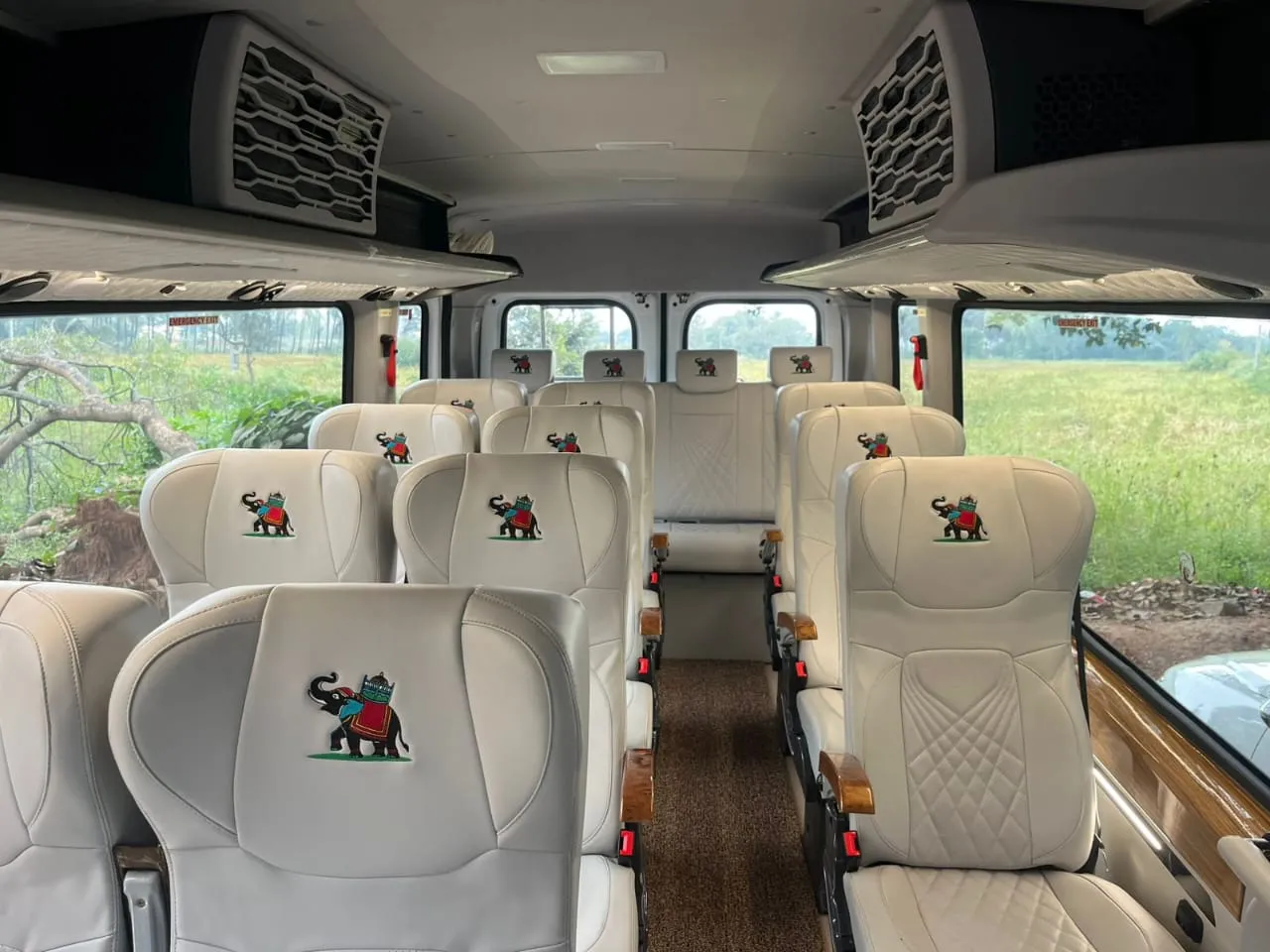
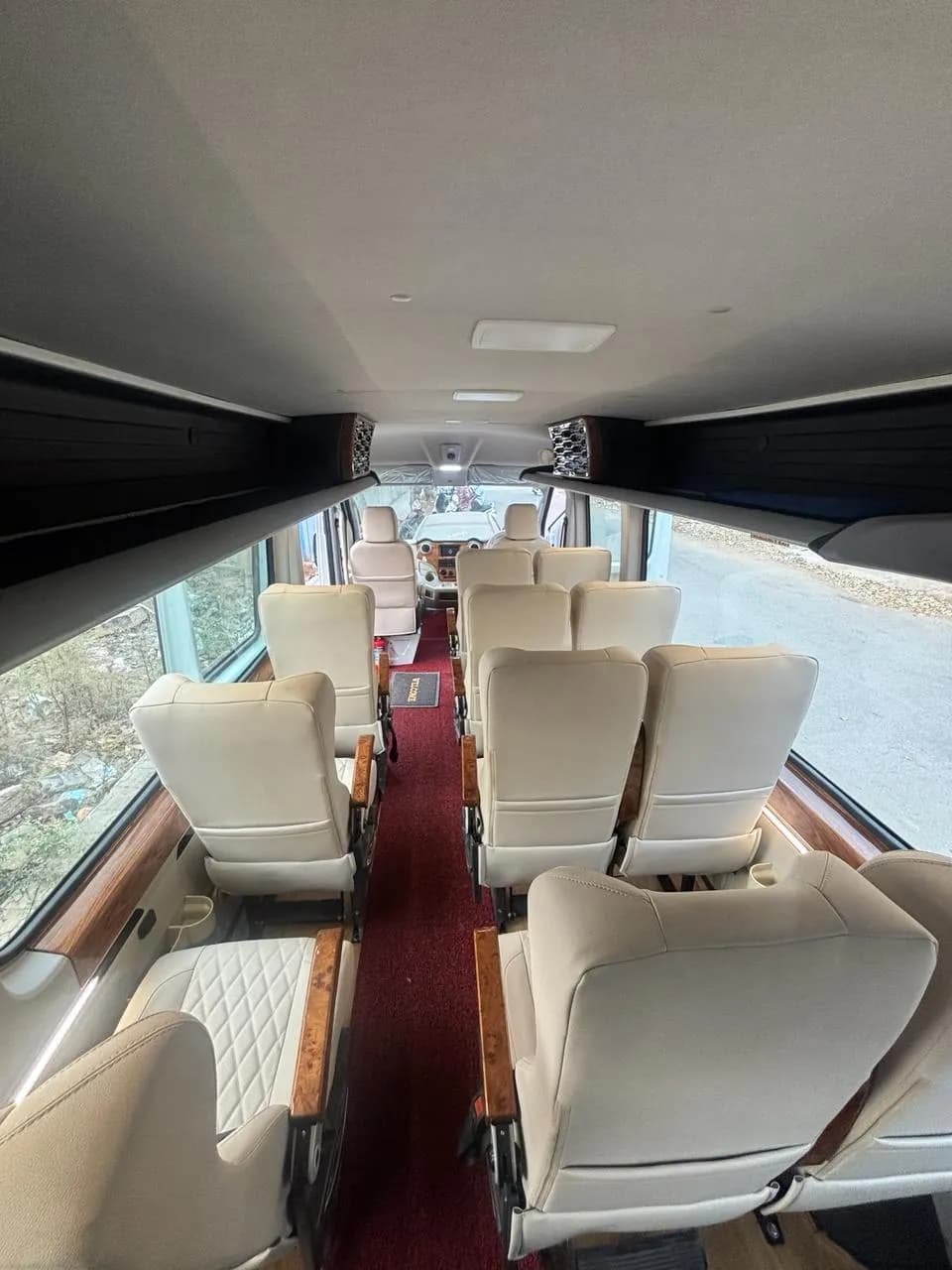
The Force Urbania boasts an interior ceiling height of 1900 mm (6 feet 3 inches), allowing adults to stand fully upright and walk through the central aisle effortlessly. With 16 individual luxury contoured bucket seats, each passenger enjoys high-density lumbar support, pushback recline, individual armrests, and 3-point ELR seatbelts.
Stepping inside the passenger cabin of the Force Urbania 16-Seater reveals an interior environment engineered around human ergonomics rather than commercial seating density. In traditional passenger vans, entering and moving through the cabin requires passengers to duck, bend, and awkwardly shuffle down narrow aisles. For senior citizens, tall passengers, or travelers carrying hand luggage, boarding an older minibus is an uncomfortable physical challenge.
The Urbania eliminates this discomfort entirely through its expansive vertical architecture. The interior cabin ceiling stands at an impressive 1900 millimetres (6 feet 3 inches) from floor to roof lining. An adult of above-average height can walk straight down the central aisle fully upright without tilting their head or stooping. This generous vertical volume creates a bright, airy, uncluttered cabin atmosphere that prevents the feelings of claustrophobia common on long-distance group journeys.
Seating Ergonomics & Anatomy: The cabin is configured in an optimized 2+1 seating layout with an open central gangway, providing 16 individual forward-facing passenger seats plus the driver’s cockpit. These are not flat bench seats; they are anatomically sculpted, luxury bucket-style captain recliners manufactured with multi-density polyurethane foam. The seat base incorporates high-resilience foam that distributes passenger body weight evenly, reducing pressure hotspots along the ischial tuberosities (sit bones) during drives exceeding four hours.
Each seat features deep lateral side bolsters that gently cradle the torso during highway cornering, preventing passengers from sliding across the seat. An integrated ergonomic headrest supports the cervical spine, while individual padded armrests allow travelers to rest their shoulders in a natural posture. The pushback recline mechanism provides up to 125 degrees of smooth backward adjustment, allowing passengers to recline comfortably for restful sleep without encroaching excessively on the knee room of the passenger seated behind.
Passenger Safety & Individual Amenities: Every single passenger seat in the Sushi Travels 16-seater Urbania is factory-fitted with an individual three-point Emergency Locking Retractor (ELR) seatbelt. While standard commercial regulations in India historically mandated only lap belts for rear rows, the Urbania’s 3-point ELR belts provide full diagonal chest and pelvic restraint, holding occupants securely in the event of sudden emergency braking. Beside each seat, passengers have access to personal smartphone storage pockets, fold-away bottle holders accommodating one-litre water bottles, and dedicated USB charging points to keep mobile devices powered throughout the trip.
5. Twin-Compressor Climate Control & Acoustic NVH Isolation
Thermal Management in 40°C Heat & Whisper-Quiet Highway Cruising
South Indian road trips span dramatically diverse climatic zones, ranging from the blazing 38°C to 42°C summer heat of the Tamil Nadu and Andhra plains to the humid coastal corridors of Mangalore and the crisp, chilly 12°C mornings of Ooty and Kodaikanal. Maintaining a uniformly comfortable cabin temperature across all 16 passenger seats requires immense air conditioning capacity and intelligent air distribution.
The Force Urbania is equipped with an advanced twin-compressor, dual-evaporator climate control system. Rather than relying on a single engine-driven compressor that struggles to cool a massive 16-passenger cabin volume, the Urbania employs two independent, high-capacity cooling circuits. One dedicated circuit manages the front driver cockpit and windshield demisting, while a separate high-output roof-mounted condenser and evaporator unit conditions the main passenger saloon.
Air is routed through an insulated longitudinal ceiling duct running the entire length of the cabin. Crucially, cooling is not blasted indiscriminately from a single rear blower. Every passenger row features dedicated, individual directional air louvers positioned directly above each seat. Passengers can independently adjust the airflow volume, direction, or shut off their individual vent entirely without affecting the comfort of travelers in adjacent rows. Even when the vehicle is parked under direct midday sun in Tirupati or Mysore, the twin-compressor system achieves full cabin pull-down to a cool 22°C within eight minutes of engine startup.
Acoustic Insulation & Panoramic Sealed Glazing: Long-distance travel fatigue is heavily driven by acoustic sensory overload—the continuous drone of engine vibration, wind turbulence against window seams, and tire roar from coarse asphalt. The Urbania achieves remarkable acoustic isolation through its flush-mounted panoramic side glass panels. Unlike sliding windows with loose felt channels that rattle and leak air at highway speeds, the Urbania’s large panoramic windows are structural, sealed, flush-bonded glass units.
The cabin bulkheads, engine firewall, wheel arches, and floor pan are lined with multi-layer acoustic dampening sheets and high-density polyurethane insulation. At a cruising speed of 80 km/h on the Bangalore-Mysore Expressway, interior decibel meters record cabin ambient noise levels below 64 decibels—a figure comparable to premium executive sedans. Passengers can conduct crystal-clear telephone conversations, listen to soft music through the vehicle’s multi-speaker audio system, or converse across rows in normal speaking tones without raising their voices.
6. Enclosed Rear Cargo Hold, Luggage Volumetrics & Baggage Safety
Luggage Storage Capacity for 16 Check-in Bags Without Rooftop Racks
Zero Rooftop Carriers: All 14–16 Bags Protected Inside
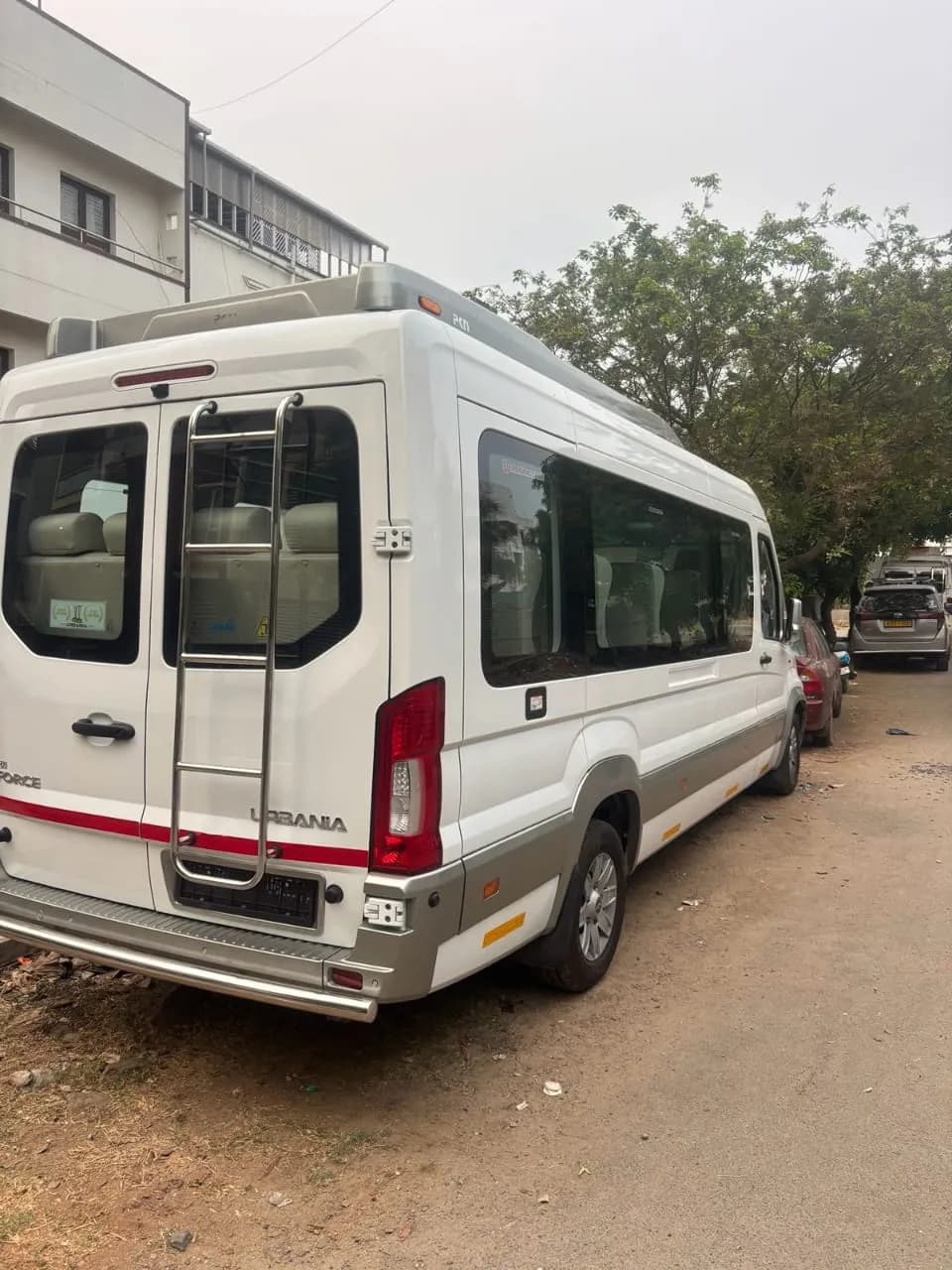
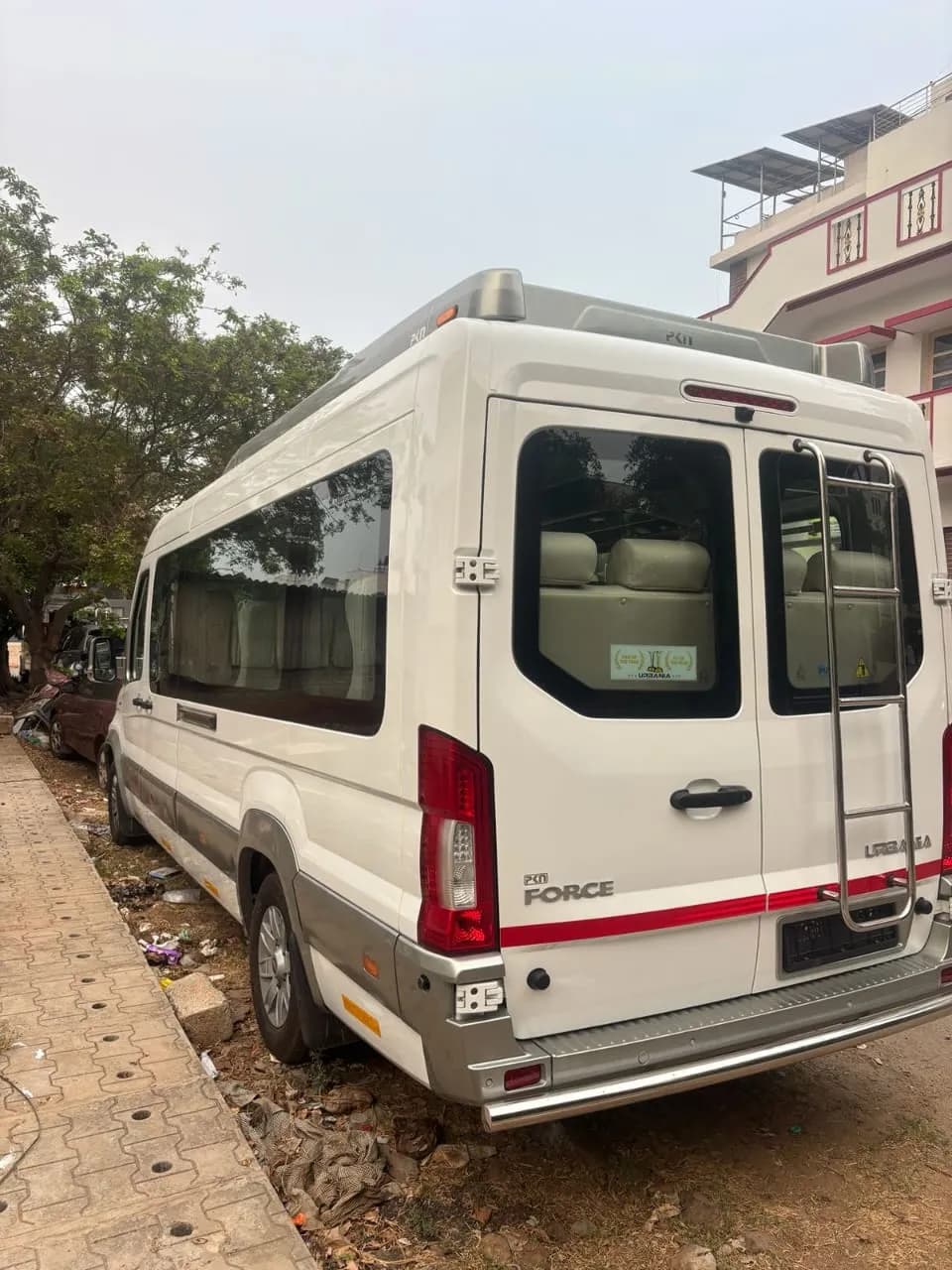
The 16-seater Force Urbania features a cavernous, fully enclosed rear luggage hold capable of swallowing 14 to 16 full-sized 28-inch check-in suitcases plus soft carry-on bags. Housing all luggage inside the vehicle’s sealed rear boot protects bags from rain, dust, and theft while eliminating the aerodynamic drag and vehicle sway caused by top roof carriers.
One of the most persistent complaints among group travelers hiring traditional Tempo Travellers or commercial vans is luggage management. In older 12-to-17-seater vans, rear luggage space behind the last row of seats is severely constrained, often measuring less than 1.5 feet in depth. When a group of 15 to 16 passengers travels with full holiday or wedding baggage, the rear boot fills up after just five or six bags.
To accommodate the remaining bags, conventional operators resort to mounting heavy steel luggage carriers on the vehicle roof, covering passenger bags with plastic tarpaulins and tying them down with ropes. This rooftop carrier approach introduces severe compromises:
• Monsoon Water Damage & Highway Dust: Even heavy-duty tarpaulins frequently leak during intense Western Ghats monsoon downpours, soaking clothes, electronics, and delicate fabrics. On dry highway corridors, fine diesel soot and red road dust penetrate zipper seams, leaving suitcases filthy upon arrival.
• Vehicle Instability & Elevated Center of Gravity: Loading 300 to 400 kilograms of luggage onto a vehicle’s roof raises its roll center dramatically. In high-speed highway lane changes or crosswinds on elevated expressway bridges, rooftop luggage acts as a sail, causing unsettling vehicle sway and body lean.
• Aerodynamic Drag & Noise: Rooftop racks disrupt laminar airflow, creating loud wind buffeting, whistling noise above passenger heads, and reducing highway fuel efficiency by 15% to 20%.
The Force Urbania 16-Seater solves this problem definitively through its lengthened rear overhang and dedicated internal cargo hold. Opening the wide twin rear doors reveals a deep, tall, enclosed luggage bay measuring over 1.8 cubic metres in volume. The compartment easily accommodates 14 to 16 full-sized (28-inch) hard-shell trolley suitcases placed vertically and horizontally, with ample room remaining above for soft duffel bags, backpacks, wedding wardrobe boxes, and food hampers.
Because all luggage is enclosed inside the vehicle’s weather-sealed, locked rear shell, passenger bags remain completely bone-dry, spotless, and secure throughout the journey. Furthermore, interior aircraft-style overhead parcel racks run along both sides of the cabin ceiling, providing convenient stowage for laptop backpacks, camera bags, jackets, blankets, and personal medication kits, keeping the passenger footwells completely clear of clutter.
7. Hyper-Local Bangalore Neighborhood Guide & Departure Planning
Doorstep Pickup Corridors, Tech Park Hubs & Highway Exit Windows
Operating from our central fleet operations base in Bengaluru, Sushi Travels provides seamless, punctual doorstep pickup and drop services across every major residential neighborhood, tech corridor, and commercial micro-market in the city. Navigating Bangalore’s complex traffic network requires strategic departure timing to ensure that your outstation road trip begins smoothly without losing two hours in intra-city gridlock.
East Bangalore Pickup Corridors (Whitefield, Outer Ring Road, Sarjapur):
Home to Bangalore’s premier IT hubs—including International Tech Park Bangalore (ITPL), EPIP Zone, RMZ Ecospace, Prestige Tech Park, and Embassy TechVillage—this corridor represents our highest volume of corporate offsite and family holiday departures. For groups departing from Whitefield, Kadugodi, Brookefield, Marathahalli, Bellandur, Varthur, or Sarjapur Road heading towards Mysore, Coorg, or Ooty, our dispatch team routes the Urbania via the NICE Ring Road (accessible via Sarjapur or Hosur Road exits), bypassing city center traffic entirely. Recommended departure timing: 6:00 AM on weekends to clear the electronic toll plaza before morning peak rush.
South Bangalore Residential Hubs (Koramangala, HSR Layout, Jayanagar, JP Nagar, BTM):
These established residential localities house large joint families and tech professionals. For departures from Koramangala (all 8 blocks), HSR Layout (Sectors 1 to 7), BTM Layout, Jayanagar (1st to 9th Blocks), JP Nagar (Phases 1 to 9), Bannerghatta Road, and Kanakapura Road heading West toward Mysore, Coorg, or Wayanad, the vehicle enters NICE Road at Bannerghatta or Kanakapura interchange, connecting directly to the Bangalore-Mysore Expressway (NH275) within 25 minutes.
Central Bangalore & Business Districts (Indiranagar, MG Road, Malleshwaram, Rajajinagar):
Departures from Indiranagar (100 Feet Road, Defense Colony), Domlur, Richmond Town, Lavelle Road, Cunningham Road, Malleshwaram, and Rajajinagar are scheduled with direct arterial access. For North-West routes toward Chikmagalur, Hampi, or Shimoga, the Urbania exits via Yeshwanthpur and the elevated Nelamangala toll expressway (NH48). Recommended departure: 5:45 AM to 6:15 AM.
North Bangalore & International Airport Zone (Hebbal, Yelahanka, Manyata Tech Park, BLR Airport):
Covering Sahakar Nagar, Thanisandra, Hennur, Manyata Embassy Business Park, Vidyaranyapura, Yelahanka, Jakkur, Devanahalli, and Kempegowda International Airport (BLR). For outstation corporate delegations or families arriving via domestic or international flights, Sushi Travels offers flight-tracked airport pickups with a complimentary 45-minute flight delay waiting buffer. The chauffeur meets your party at the commercial pickup zone with a digital paging board and assists with all 16 passenger bags.
West Bangalore Corridors (Yeshwanthpur, Vijayanagar, Kengeri, Mysore Road):
Proximity to our Nagadevana Halli / Kengeri headquarters allows rapid vehicle dispatch for residents in Vijayanagar, Basaveshwaranagar, Nagarbhavi, Kengeri Satellite Town, and Mysore Road. Departures from this sector enter the 10-lane NH275 expressway within minutes.
| Bangalore Locality / Hub | Primary Highway Corridor | Recommended Morning Exit Window | Optimal Bypass Route |
|---|---|---|---|
| Whitefield / ITPL / Kadugodi | NH275 (Mysore) / NH44 (Ooty) | 5:45 AM – 6:15 AM | Via Varthur – Sarjapur – NICE Road Entry |
| Electronic City (Phase 1 & 2) | NH44 (Salem/Ooty) / NH275 (Coorg) | 6:00 AM – 6:30 AM | Direct NICE Road Electronic City Interchange |
| Koramangala / HSR Layout | NH275 (Mysore) / NH75 (Chikmagalur) | 5:45 AM – 6:15 AM | Via Silk Board – BTM – Bannerghatta NICE Entry |
| Indiranagar / Domlur | NH75 (Chikmagalur) / NH48 (Hampi) | 5:30 AM – 6:00 AM | Via Old Airport Road – Inner Ring – Yeshwanthpur |
| Jayanagar / JP Nagar | NH275 (Coorg/Ooty/Mysore) | 6:00 AM – 6:30 AM | Via Kanakapura Road – NICE Road Interchange |
| Hebbal / Manyata Tech Park | NH48 (Hampi) / NH75 (Tirupati) | 6:00 AM – 6:30 AM | Via Elevated Airport Road / ORR Goraguntepalya |
| Yelahanka / Devanahalli (BLR) | NH44 (Hyderabad) / NH75 (Tirupati) | Anytime (24/7 Flight Tracking) | Direct 6-lane NH44 Airport Expressway Corridor |
| Kengeri / Nagadevana Halli | NH275 (Mysore / Coorg / Wayanad) | 6:15 AM – 6:45 AM | Immediate access to Bangalore-Mysore Expressway |
8. Comprehensive Outstation Route Masterclass: 12 Major Corridors
Distance, Drive Times, Highway Corridors, Tolls & Mountain Road Notes
The 16-seater Force Urbania is purpose-built for South India’s premier highway corridors and mountain passes. Below is the definitive operational breakdown of the 12 most frequently booked outstation routes from Bangalore, detailing road conditions, toll plazas, driving durations, and vehicle dynamic performance:
1. Bangalore to Mysore & Srirangapatna (143 km | 2.5 – 3.0 Hours | NH275):
Cruising along the 10-lane access-controlled Bangalore-Mysore Expressway (NH275) is effortless in the Urbania. The vehicle maintains a steady, GPS-governed 80 km/h cruising speed with exceptional lane stability. Key stops include Bidadi (famous for Thatte Idli), Ramanagara silk town, Channapatna wooden toy workshops, and the historic island fortress of Srirangapatna. Two automated FASTag toll gantries (Kaniminike and Ganangur) ensure non-stop transit. Perfect for same-day heritage round trips or weekend palace tours.
2. Bangalore to Coorg / Kodagu (250 km | 5.5 – 6.0 Hours | NH275 via Hunsur):
The premier coffee-estate holiday corridor. The route follows the expressway to Mysore ring road, turns onto state highway via Bilikere and Hunsur, passes the Tibetan Golden Temple at Kushalnagar, and climbs into Madikeri. The Urbania’s independent front suspension absorbs the undulating plantation tarmac smoothly, shielding passengers from fatigue.
3. Bangalore to Ooty & Coonoor (270 km | 6.0 – 7.0 Hours | NH44 & NH766 via Bandipur):
Running south via Hosur Road (or Mysore expressway) through Nanjangud and Gundlupet into the Bandipur Tiger Reserve forest corridor. Forest transit speed is strictly monitored at 30–40 km/h with a complete night driving ban between 9:00 PM and 6:00 AM. After crossing into Tamil Nadu at Mudumalai, travelers choose between the scenic Gudalur route or the thrilling 36 hairpin bends of Kalhatty Ghat. The Urbania’s low center of gravity virtually eliminates passenger motion sickness across all 36 switchbacks.
4. Bangalore to Chikmagalur & Mullayanagiri (245 km | 5.0 – 5.5 Hours | NH75 via Hassan):
Exiting Bangalore via the Nelamangala elevated tollway onto the butter-smooth 4-lane NH75 through Kunigal, Bellur Cross, and Channarayapatna to Hassan, before turning towards Belur and Chikmagalur. The final ascent towards Mullayanagiri (Karnataka’s highest peak) involves narrow ghat roads where the Urbania’s tight turning radius and powerful low-end torque shine.
5. Bangalore to Wayanad (285 km | 6.0 – 6.5 Hours | NH275 & NH766 via Sulthan Bathery):
Following the Mysore corridor into Gundlupet, branching toward Muthanga Wildlife Sanctuary and Sulthan Bathery in Kerala. Ideal for corporate retreats and large families visiting Banasura Sagar Dam, Edakkal Caves, and Chembra Peak.
6. Bangalore to Hampi & Vijayanagara (340 km | 6.0 – 7.0 Hours | NH48 & NH50):
Connecting Bengaluru to the UNESCO World Heritage monuments of the Vijayanagara Empire. The 4-lane highway via Tumakuru, Chitradurga (famous for the stone fort), and Hospet allows relaxed high-speed cruising with minimal driver fatigue.
7. Bangalore to Tirupati & Tirumala (250 km | 5.0 – 5.5 Hours | NH75 & NH40 via Chittoor):
South India’s busiest pilgrimage route. Departing via Hoskote and Kolar (famed for Kamat and Woody’s breakfast stops) through Mulbagal and Palamaner into Andhra Pradesh. Senior citizens praise the Urbania’s low step-in height and easy walk-in cabin when visiting Lord Venkateswara Temple.
8. Bangalore to Pondicherry (310 km | 6.0 – 7.0 Hours | NH77 via Krishnagiri & Tiruvannamalai):
Popular weekend beach escape traversing Krishnagiri, Uthangarai, and the temple town of Tiruvannamalai to the French colonial promenade of Puducherry.
9. Bangalore to Kabini & Nagarhole (215 km | 4.5 – 5.0 Hours | NH275 via HD Kote):
Leading wildlife safari destination on the banks of the Kabini River, famed for tiger and black panther sightings. Smooth highway travel followed by tranquil forest approaches.
10. Bangalore to Sakleshpur (220 km | 4.5 – 5.0 Hours | NH75 via Hassan):
Lush coffee plantations, Manjarabad star fort, and the breathtaking Bisle Ghat viewpoint overlooking the Western Ghats mountain ridge.
11. Bangalore to Kodaikanal (465 km | 8.0 – 9.0 Hours | NH44 via Salem & Dindigul):
A comprehensive long-distance holiday route heading south along the 6-lane NH44 through Salem and Karur before ascending the 50-kilometre Batlagundu Ghat into Princess of Hill Stations.
12. Bangalore to Goa (580 km | 10.0 – 11.0 Hours | NH48 via Hubballi & Dharwad):
The classic group holiday adventure. Fast 6-lane running on NH48 to Hubballi, followed by the lush Anmod Ghat or Chorla Ghat descent into North or South Goa.
| Destination Circuit | One-Way Distance | Typical Drive Time | Recommended Tour Duration | Primary Highway Route |
|---|---|---|---|---|
| Bangalore to Mysore & Srirangapatna | 143 km | 2.5 – 3.0 hrs | 1 Day (Round Trip) | Bangalore-Mysore Expressway (NH275) |
| Bangalore to Coorg (Madikeri/Kushalnagar) | 250 km | 5.5 – 6.0 hrs | 2 Days / 1 Night | NH275 via Mysore & Hunsur |
| Bangalore to Ooty & Coonoor | 270 km | 6.0 – 7.0 hrs | 2 Days / 1 Night | NH44 / NH766 via Bandipur & Nilgiri Ghats |
| Bangalore to Chikmagalur & Mullayanagiri | 245 km | 5.0 – 5.5 hrs | 2 Days / 1 Night | NH75 via Nelamangala & Hassan |
| Bangalore to Wayanad (Sulthan Bathery) | 285 km | 6.0 – 6.5 hrs | 2 Days / 1 Night | NH275 / NH766 via Gundlupet & Muthanga |
| Bangalore to Hampi & Vijayanagara | 340 km | 6.0 – 7.0 hrs | 3 Days / 2 Nights | NH48 / NH50 via Chitradurga & Hospet |
| Bangalore to Tirupati & Tirumala | 250 km | 5.0 – 5.5 hrs | 1 to 2 Days | NH75 / NH40 via Kolar & Chittoor |
| Bangalore to Pondicherry (Puducherry) | 310 km | 6.0 – 7.0 hrs | 2 Days / 1 Night | NH77 via Krishnagiri & Tiruvannamalai |
| Bangalore to Kabini & Nagarhole National Park | 215 km | 4.5 – 5.0 hrs | 2 Days / 1 Night | NH275 via Mysore & HD Kote Handpost |
| Bangalore to Sakleshpur & Bisle Ghat | 220 km | 4.5 – 5.0 hrs | 2 Days / 1 Night | NH75 via Kunigal, Channarayapatna & Hassan |
| Bangalore to Kodaikanal (Tamil Nadu) | 465 km | 8.0 – 9.0 hrs | 3 Days / 2 Nights | NH44 via Salem, Dindigul & Batlagundu Ghat |
| Bangalore to Goa (Panaji / Calangute) | 580 km | 10.0 – 11.0 hrs | 4 Days / 3 Nights | NH48 via Tumakuru, Davanagere, Hubballi & Dharwad |
9. Corporate Transport, IT Offsites & Executive MICE Logistics
Seamless Mobility for Technology Teams, Leadership Offsites & Client Visits
Bangalore is India’s Silicon Valley, home to over 4,000 active technology startups, global capability centers (GCCs), and multinational enterprise campuses. When engineering departments, executive leadership boards, and corporate project teams plan strategic offsites, team-building retreats, or client hospitality excursions, transportation logistics set the professional tone for the entire event.
Why Technology Companies Choose the 16-Seater Urbania over Multiple Cabs:
• Shared Team Cohesion: Splitting a 15-person department across three or four separate sedans or SUVs fragments the group. Team members arrive at different times, endure staggered toll delays, and lose the valuable shared bonding time that occurs during a four-hour road trip. In the 16-seater Urbania, the entire team travels together in a unified, executive atmosphere.
• Mobile Productivity & On-Board Power: The vehicle’s whisper-quiet acoustic insulation permits spontaneous discussions, project retrospectives, and presentations while on the move. With individual USB charging ports at each seat and auxiliary 12V/220V power connectivity, team members can keep laptops, tablets, and smartphones fully charged throughout the journey.
• Corporate Billing & GST Compliance: Sushi Travels provides enterprise-grade billing services, including official commercial tax invoices with 5% GST input tax credit (ITC) eligibility, itemized electronic FASTag toll statements, and vendor compliance paperwork. Corporate accounts enjoy dedicated dispatch managers and priority vehicle reservations.
• Vetted Chauffeurs: Corporate travel requires absolute punctuality, professional deportment, and defensive driving. All Sushi Travels chauffeurs assigned to corporate contracts wear clean uniforms, possess police-cleared background credentials, maintain non-smoking and alcohol-free operating standards, and speak English, Kannada, and Hindi for seamless communication.
10. Luxury Destination Weddings & Guest Shuttles in Bangalore
Multi-Venue Coordination, Airport Convoys & Wedding Couture Care
Weddings in Bangalore are grand, multi-day celebrations spanning diverse ceremonial venues across the city—from traditional heritage mandapas in Basavanagudi and Malleshwaram to sprawling luxury convention estates along Palace Grounds, Kanakapura Road, Yelahanka, and Nelamangala. Coordinating the transit of out-of-town wedding guests, extended family elders, and the bridal party requires precision logistics.
The 16-seater Force Urbania has become Bangalore’s most requested luxury wedding van for four distinct operational reasons:
1. Wedding Wardrobe & Jewelry Box Protection: Indian weddings involve heavy, delicate traditional attire—including pure Kanjeevaram silk sarees, embroidered bridal lehengas, sherwanis, and ornate turbans. In traditional vans with rooftop luggage carriers, these valuable garments risk moisture damage and dust contamination. The Urbania’s clean, dust-sealed, climate-controlled rear cargo hold ensures that wedding couture arrives pristine and ready for the ceremony.
2. Elderly Family Comfort & Saree Mobility: Navigating traditional ceremonies is physically demanding for grandparents and elderly relatives. The Urbania’s low entry step-in height (under 420 mm), wide powered sliding entrance door, sturdy grab pillars, and wide central aisle allow senior citizens and women wearing heavy sarees to enter and exit gracefully without tripping.
3. Punctual Airport & Railway Station Convoys: When 14 to 16 wedding guests arrive together on a flight at Kempegowda International Airport (BLR) or by train at KSR Bengaluru / Yeshwanthpur terminals, coordinating four separate app cabs creates chaos with mismatched arrival times. A single 16-seater Urbania receives all guests and their luggage in one coordinated pickup, transferring them directly to their hospitality hotel.
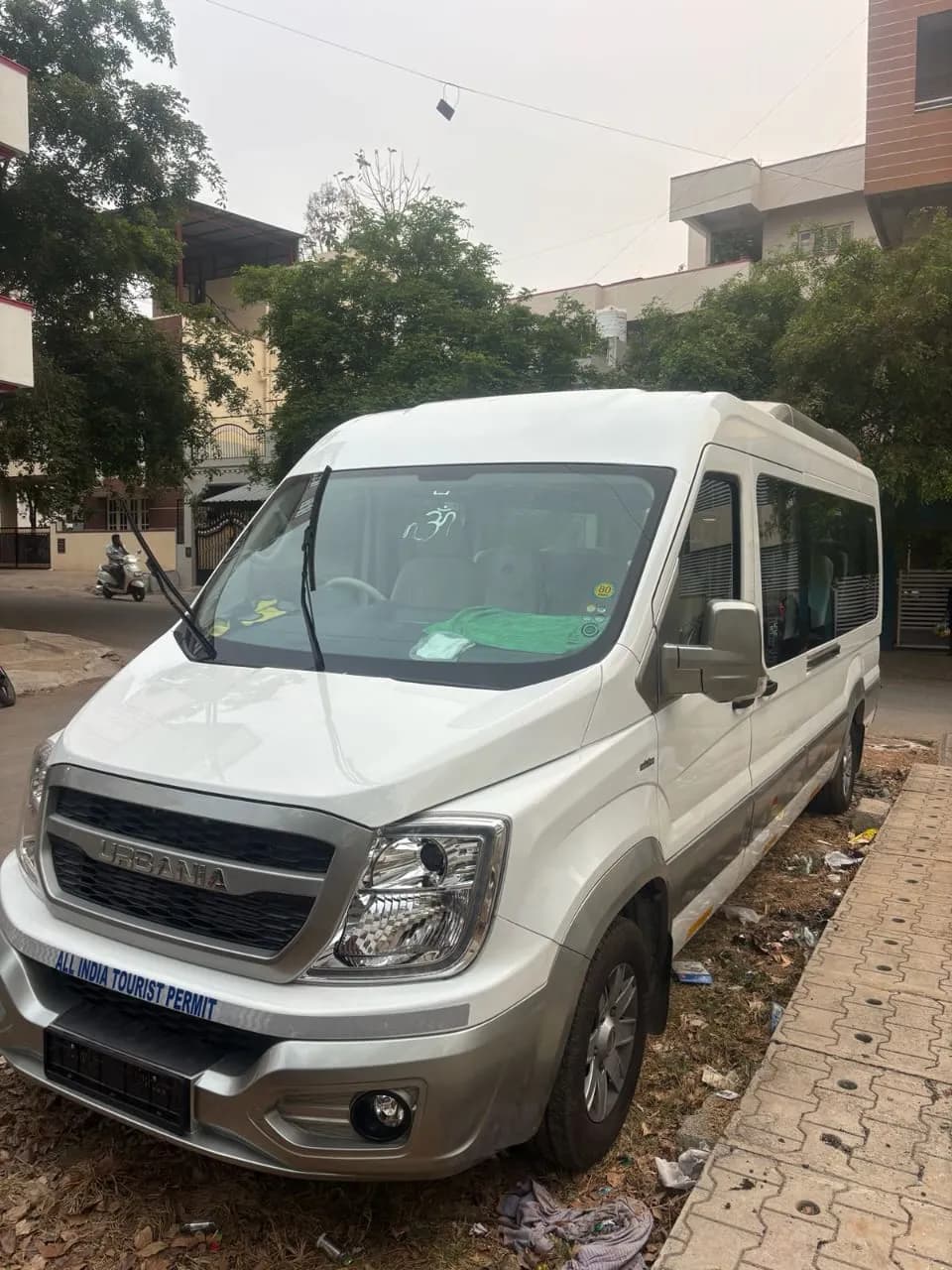
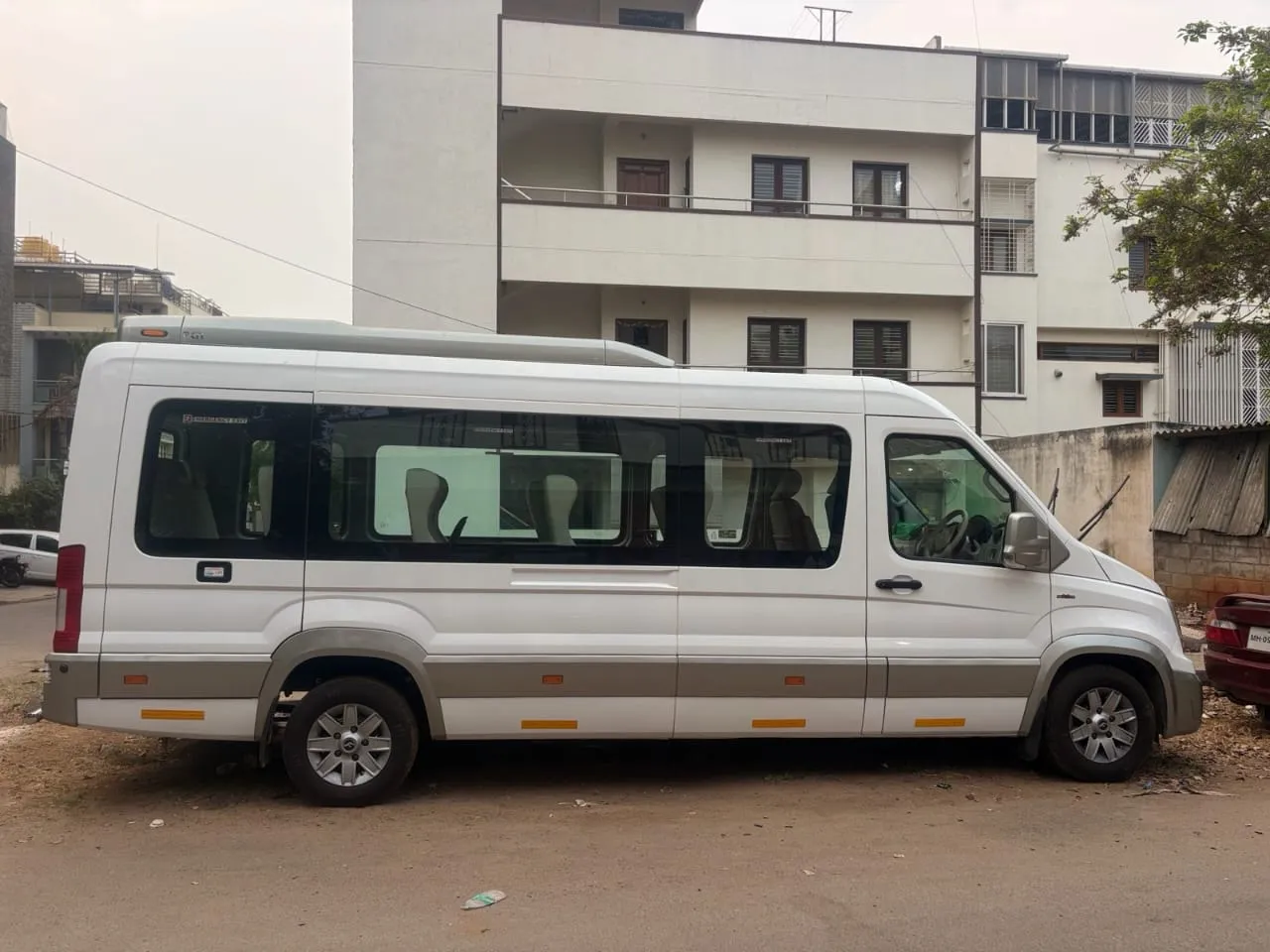
4. Prestige & Aesthetic Elegance: With its sleek aerodynamic European silhouette, flush panoramic dark-tinted glazing, modern LED projector headlamps, and pristine white exterior finish, the Force Urbania looks handsome and distinguished in wedding photo albums and video drone shots.
11. Multi-Vehicle Head-to-Head Comparison Matrix
Force Urbania 16 vs 17-Seater Tempo Traveller vs 12-Seater vs 2 × Innova Crysta
The Innova Crysta Dilemma: 1 Urbania vs 2 Innovas
A group of 14 passengers often debates booking two Toyota Innova Crystas (₹19/km × 2 = ₹38/km) versus one 16-seater Force Urbania (₹38/km). While the base per-km rate is identical (₹38/km), booking two Innovas doubles your driver bata (2 × ₹400 = ₹800 vs ₹700), doubles your highway toll charges at every toll plaza, separates your group, and leaves zero space for luggage when 7 passengers occupy each Innova!
To assist group organizers, corporate administrative heads, and travel coordinators in making an informed fleet decision, the comparison table below contrasts the 16-Seater Force Urbania against the most common group transport alternatives available in Bangalore:
| Evaluation Parameter | Force Urbania 16-Seater | 17-Seater Tempo Traveller | Two Toyota Innova Crystas | 25-Seater Mini Bus |
|---|---|---|---|---|
| Passenger Seating Capacity | 16 Passengers + 1 Driver | 17 Passengers + 1 Driver | 14 Passengers (7 per car) | 25 Passengers + 1 Driver |
| Vehicle Architecture | Monocoque Unibody (European) | Ladder-Frame (Truck-derived) | Ladder-Frame SUV Chassis | Heavy Ladder-Frame Coach |
| Front Suspension System | Independent Transverse Leaf | Rigid Axle Parabolic Leaf | Independent Double Wishbone | Rigid Multi-Leaf Springs |
| Interior Ceiling Height | 1900 mm (6.23 ft Stand-up) | 1800 mm (5.9 ft) | 1200 mm (Car-height crawl) | 2000 mm (Coach stand-up) |
| Ghat Road Body Roll | Minimal (Low roll center & ESP) | Moderate to High Body Sway | Minimal (Low car height) | Moderate (High center of mass) |
| Rear Luggage Capacity | 14–16 large suitcases in boot | 12–14 medium bags in boot | Almost Nil with 7 pax loaded | 25–30 bags in belly hold |
| Outstation Rate (AC) | ₹38 / km | ₹30 / km (₹28 Non-AC) | ₹38 / km (₹19/km × 2 cars) | Price on Request (Per trip) |
| Daily Minimum Kilometres | 300 km / calendar day | 300 km / calendar day | 300 km / day per car (600 km) | Quoted per itinerary |
| Daily Driver Bata Total | ₹700 / day | ₹700 / day | ₹800 / day (₹400 × 2 drivers) | Quoted in trip package |
| Highway Toll Plaza Cost | Single commercial FASTag | Single commercial FASTag | DOUBLE Tolls (Paid for 2 cars) | Commercial bus toll rate |
| Group Unity & Cohesion | 100% United in 1 cabin | 100% United in 1 cabin | SPLIT across two separate cars | 100% United in 1 coach |
| City Road Manoeuvrability | Excellent (6.5m turning radius) | Good | Superior (Passenger cars) | Restricted on narrow streets |
12. Statutory Safety, ARAI Crashworthiness & Chauffeur Standards
Active Electronic Safety, Passive Impact Protection & Driver Verification
Commercial passenger transport safety is not merely a marketing claim; it is a statutory discipline governed by central automotive regulations, periodic fitness testing, and professional driver management. Sushi Travels enforces rigorous safety protocols across its entire Force Urbania fleet:
• Automotive Research Association of India (ARAI) Compliance: The Force Urbania is fully certified under the Ministry of Heavy Industries’ Automotive Industry Standards (AIS), specifically AIS-052 (Code of Practice for Bus Body Design and Approval). Its monocoque structure has undergone computer-simulated crash barrier testing, frontal collision absorption trials, and European ECE R66 rollover compliance testing. In the event of an impact, engineered front crumple zones deform progressively to absorb kinetic energy, while the reinforced passenger cell remains structurally intact.
• Active Electronic Braking & ESP: The vehicle is equipped with high-performance disc brakes on all four wheels, paired with dual-circuit hydraulic vacuum assistance. Standard active electronics include Anti-lock Braking System (ABS) with Electronic Brakeforce Distribution (EBD) to prevent wheel lockup on wet monsoon tarmac. Furthermore, standard Electronic Stability Program (ESP) continuously monitors individual wheel rotational speeds, steering angle, and lateral yaw sensors; if the system detects imminent understeer or fish-tailing, it automatically modulates throttle output and applies micro-braking to individual wheels, stabilizing the vehicle instantaneously.
• MoRTH Directives & Speed Governors: Every Urbania in our fleet is fitted with a government-certified electronic speed governor calibrated strictly to 80 km/h in full compliance with Ministry of Road Transport and Highways (MoRTH) commercial passenger safety mandates. This prevents hazardous highway speeding, stabilizes fuel consumption, and ensures passenger peace of mind.
• Professional Chauffeur Selection & Vetting: A vehicle is only as safe as the professional behind the steering wheel. All chauffeurs assigned to the 16-seater Urbania fleet undergo rigorous screening, including background verification through local police authorities, commercial heavy-passenger vehicle licensing verification, and a mandatory minimum of five years of unblemished commercial highway and mountain ghat driving experience across South India. Chauffeurs adhere to a strict zero-tolerance alcohol and substance policy with periodic breathalyzer spot-checks before vehicle dispatch.
13. Booking Process, Reservation Terms & Advance FAQ Masterclass
How to Reserve Your 16-Seater Force Urbania with Sushi Travels
Reserving your 16-seater Force Urbania with Sushi Travels is designed to be seamless, professional, and transparent:
Step 1: Route & Date Enquiry: Contact our 24/7 Bangalore travel desk via phone or WhatsApp at +919071660099, or submit our online booking form. Provide your travel dates, pickup locality in Bangalore, intended outstation itinerary, and estimated group size.
Step 2: Transparent Written Quotation: Our dispatch manager generates an itemized quotation outlining the estimated total distance, base per-km rate (₹38/km), minimum daily billing (300 km/day), driver bata (₹700/day), and estimated highway tolls and state permits.
Step 3: Reservation Confirmation & Advance: Confirm your booking with a standard booking advance. Your vehicle is immediately locked into our fleet calendar, and an official booking receipt is generated.
Step 4: Chauffeur & Vehicle Allocation: Exactly 12 to 24 hours prior to departure, our operations team sends you an automated SMS and WhatsApp confirmation containing the vehicle registration number, photograph, and your chauffeur’s direct contact details.
Step 5: Punctual Doorstep Arrival: Your chauffeur arrives at your designated Bangalore pickup address 15 minutes ahead of schedule with a fully washed, interior-sanitized, and fuel-topped Force Urbania ready for departure.
Cancellation & Refund Policy: We understand that group travel schedules can change unexpectedly. Cancellations made more than 24 hours prior to departure receive a 100% full refund of the booking advance. Cancellations made between 12 and 24 hours prior receive a 50% refund. Cancellations made under 12 hours or no-shows forfeit the advance to cover chauffeur dispatch allocation.
14. Luggage Packing & Pre-Departure Volumetrics Playbook
Baggage Dimension Formulas, Golf Bags, Musical Gear, Wedding Wardrobe & Stroller Placement
Luggage Physics & Volumetric Capacity for 16 Passengers
The Force Urbania 16-Seater provides an internal luggage bay of over 1.8 cubic metres (1,850+ litres), engineered to hold 14–16 standard 28-inch check-in hard-shell suitcases vertically stacked, plus soft bags and backpack carry-ons in passenger overhead parcel shelves. No rooftop carrier or tarpaulin tie-downs are required.
Managing luggage for 16 adult passengers on a multi-day outstation tour presents a major logistical challenge in standard commercial minibuses. In conventional passenger vans, luggage is either precariously strapped to an external rooftop luggage carrier under plastic tarpaulins—exposing expensive baggage to highway dust, sudden monsoon deluges, and highway theft risks—or squeezed into passenger footwells, compromising passenger legroom and emergency egress routes. The Force Urbania 16-Seater eliminates these compromises with its purpose-engineered, fully integrated internal rear cargo hold.
Understanding Volumetric Luggage Geometry: A standard full-size 28-inch check-in trolley suitcase measures approximately 75 cm in height, 50 cm in width, and 30 cm in depth, displacing roughly 112.5 litres of volume. The 16-seater Urbania’s rear cargo hold offers an interior usable volume exceeding 1.85 cubic metres (1,850 litres) configured in an upright, boxy rectangular space with zero intrusive wheel arch encroachments. This geometry allows the Sushi Travels chauffeur to stack 14 to 16 hard-shell suitcases in two vertical upright tiers, keeping the weight centered directly over the vehicle’s rear axle for optimal highway balance.
Golf Bags, Trekking Rucksacks & Mountain Sports Gear: For groups traveling to the championship golf courses of South India—such as Bangalore Golf Club, Prestige Golfshire (Nandi Hills), Coorg Golf Links (Bittangala), or the Ooty Golf Course—the Urbania’s cargo bay accommodates up to 4 full-sized tour golf bags loaded flat across the floor, with standard luggage stacked above. For trekking expeditions to Kudremukh, Tadiandamol, or Mullayanagiri, large 60–85 litre internal-frame hiking rucksacks with external sleeping mats fit easily without puncturing or snagging.
Bridal Couture, Sherwanis & Designer Wedding Wardrobes: Wedding parties moving between Bangalore wedding halls (such as Palace Grounds, Tamarind Tree, TempleTree Leisure, or Golden Palms Resort) carry delicate couture garments, zardozi lehengas, silk sarees, and structured sherwanis. The Urbania cabin features individual interior garment hanging hooks positioned along the rear roof quarter-panels. This allows wedding parties to transport expensive ethnic ensembles on hangers completely flat and suspended, preventing wrinkles and avoiding costly emergency hotel pressing.
Infant Strollers, Elderly Mobility Walkers & Medical Equipment: When traveling with multi-generational families, accessibility equipment is paramount. The Urbania’s wide 180-degree twin-swing rear barn doors and low load-in sill (680 mm from ground level) permit rapid loading of folding wheelchairs, elderly walking frames, and full-size baby prams. Crucially, Sushi Travels chauffeurs position mobility aids in the immediate outer access perimeter of the luggage hold, ensuring they can be retrieved within 30 seconds at highway restaurant stops or hotel porticos without unpacking other passengers’ suitcases.
Overhead Parcel Racks for Personal Carry-on Items: In addition to the massive rear trunk, the Urbania features dual longitudinal aircraft-style overhead parcel racks running the entire length of the passenger compartment. These parcel shelves safely hold 16 executive laptop backpacks, camera bags, woollen jackets, shawls, and hydration flasks, keeping the central 350 mm walking gangway completely unobstructed throughout the journey.
| Luggage Category | Dimensions & Unit Volume | Max Safe Capacity (16 Pax Trip) | Loading Location & Chauffeur Protocol |
|---|---|---|---|
| Standard 28-inch Check-in Suitcase | 75 cm × 50 cm × 30 cm (~112 L) | 14 to 16 full-sized bags | Lower rear enclosed luggage hold, stacked vertically in 2 tiers |
| Cabin Carry-on Trolley (22-inch) | 55 cm × 35 cm × 23 cm (~44 L) | 16 to 18 bags | Stacked above primary check-in bags or on rear boot upper shelf |
| Executive Laptop Backpack / Duffel | 45 cm × 30 cm × 20 cm (~25 L) | 16 bags (1 per passenger) | Overhead longitudinal aircraft parcel racks above passenger seats |
| Full-Size Tour Golf Kit Bag | 130 cm × 35 cm × 30 cm | 3 to 4 complete tour sets | Base of rear trunk laid horizontally beneath primary luggage tier |
| Foldable Wheelchair / Elderly Walker | 90 cm × 60 cm × 30 cm (folded) | 1 to 2 units | Rear hold outer access bay for priority roadside deployment |
| Baby Stroller / Pram (Collapsible) | 65 cm × 45 cm × 25 cm (compact) | 2 units | Rear hold upper shelf or lower boot side recess |
| Designer Wedding Garment Bags | 120 cm × 60 cm × 10 cm | 4 to 6 hanging bags | Interior overhead garment hooks (wrinkle-free suspension) |
| Film & Media Flight Cases (Pelican) | Various sizes up to 1510/1650 | 4 to 6 ruggedized cases | Rear hold with heavy-duty tie-down anchor straps |
15. Season-by-Season Western Ghats Weather, Road Condition & Mountain Driving Advisory
Monsoon Water Crossings, Winter Fog Navigation on NH275 & Summer Thermal Management
All-Season Mountain Dispatch Advisory: Bangalore to Western Ghats
Traversing the Western Ghats demands vehicle resilience across torrential monsoons (June–Sept), dense Nilgiri radiation fog (Nov–Feb), and intense 38°C Deccan plateau summer heat. The Urbania’s 190 mm ground clearance, dual AC system, and ESP provide year-round all-weather mountain safety.
The geography surrounding Bangalore presents some of India’s most diverse and demanding driving environments. Within a 300-kilometre radius, routes transition from smooth multi-lane expressways across arid Deccan plains to rain-lashed rainforest passes in the Western Ghats ascending beyond 2,000 metres above sea level. Successfully operating group tours across these terrains requires comprehensive seasonal intelligence, specialized vehicle maintenance, and seasoned mountain chauffeurs.
Southwest Monsoon Operations (June to September): The Western Ghats catch the full brunt of the Indian monsoon, with regions like Agumbe, Sakleshpur, Coorg, and Wayanad recording upwards of 3,000 to 5,000 mm of annual rainfall. Crucial ghat passes—including Shiradi Ghat (NH75 linking Hassan to Mangalore), Charmadi Ghat (Mudigere to Belthangady), Bisle Ghat (Sakleshpur to Subrahmanya), and Sampaje Ghat (Madikeri to Sullia)—frequently experience cascading hillside runoff, localized mud-slips, and standing water. The Force Urbania’s 190 mm unladen ground clearance easily wades through highway drainage overflow without water entering the exhaust or mechanical air intakes. Furthermore, the unibody laser-welded seams prevent dampness and mist penetration, while the Electronic Stability Program (ESP) continuously monitors wheel speed differentials, preventing dangerous hydroplaning over slick asphalt.
Winter Radiation Fog & Temperature Inversions (November to February): Winter mornings along the Bangalore-Mysore Expressway (NH275), the Kabini river basin, Bandipur National Park corridor, and the Nilgiri foothills present heavy radiation fog where visibility frequently drops below 25 metres between 5:30 AM and 8:30 AM. Older commercial vans with yellow halogen headlamps struggle to illuminate road edges. The Force Urbania is factory-equipped with high-lux LED projector headlamps paired with low-mounted wide-beam fog lamps that cut underneath fog banks without reflecting glare back into the chauffeur’s eyes. Sushi Travels chauffeurs adhere to a strict 40 km/h fog transit ceiling, utilizing GPS guidance and active lane markers until morning solar heating disperses the mist.
High-Summer Heat & Deccan Plateau Thermal Management (March to May): When traveling north toward Hampi, Badami, or Hyderabad across the dry plains of Chitradurga and Bellary, ambient exterior temperatures regularly hit 38°C to 42°C. In poorly insulated vans, metal roof panel conductivity turns cabins into greenhouses, causing passenger fatigue, dehydration, and irritability. The Urbania features multi-layer acoustic and thermal barrier insulation embedded within the roof and side panels, combined with UV-cut tinted privacy glass. The dual 14 kW roof-mounted air conditioning compressors pull cabin temperatures down from 40°C to an optimal 21°C within 7 minutes, maintaining continuous climate comfort even when idling in toll plaza queues under midday sun.
Pre-Mountain Vehicle Inspection Protocol: Prior to dispatching a 16-seater Urbania on any Western Ghats itinerary, Sushi Travels maintenance engineers execute a mandatory 18-point mountain readiness audit. This includes measuring brake pad thickness (minimum 6 mm lining required), testing synthetic DOT 4 brake fluid moisture content to prevent vapor lock during long downhill runs, inspecting tire tread depth across all 5 wheels (minimum 4 mm depth required), and verifying radiator coolant concentration. This rigorous mechanical protocol ensures flawless ascent and descent across South India’s most demanding mountain passes.
| Season & Months | Western Ghats Corridor | Predominant Road / Weather Conditions | Chauffeur Operational Protocols & Vehicle Advantages |
|---|---|---|---|
| Southwest Monsoon (Jun–Sep) | Shiradi, Charmadi & Bisle Ghats | Heavy downpours, slippery moss, cascading road rivulets | ESP traction control engaged; 190 mm clearance clears runoff; anti-lock brakes prevent aquaplaning |
| Post-Monsoon (Oct–Nov) | Coorg, Chikmagalur & Wayanad | Lush green scenery, occasional misty drizzle, damp curves | Optimal travel season; smooth 350 Nm low-RPM hill climb; twin AC dehumidification maintains window clarity |
| Winter & Fog (Dec–Feb) | Ooty (Kalhatty), Kodaikanal & Nilgiris | Early morning dense radiation fog, 6°C hill temperatures | LED projector headlamps & wide-angle fog lamps; chauffeur 40 km/h fog safety speed; cabin heater engaged |
| Early Summer (Mar–Apr) | Hampi, Badami & Mysore Heritage | Intense direct sunshine, 36°C–39°C dry heat, open highways | Twin 14 kW compressor AC ensures constant 21°C cabin; UV-cut privacy glass reduces solar heat gain |
| Peak Summer (May) | Munnar, Sakleshpur & Dandeli | Pre-monsoon thunderstorms, humid coastal approaches | Independent suspension cushions heat-expanded asphalt joints; continuous ventilated airflow for all 16 seats |
16. Bangalore Tech Park Pickup Corridors, Corporate Event Transport & MICE Coordination Framework
Gate Protocols, Multi-Point Route Optimization & Leadership Transport at Ecospace, ITPL, Manyata, Bagmane & Electronic City
Enterprise Mobility & Bangalore IT Corridor Dispatch Protocol
Corporate offsites and leadership transport require punctual dispatch, security-vetted drivers, and coordinated pickups across Bangalore's major tech clusters. Sushi Travels provides pre-aligned gate manifests, multi-point employee pickups, and direct expressway route mapping from Whitefield, Outer Ring Road, Manyata, and Electronic City.
Bangalore is India's undisputed technology capital, hosting over 1.5 million IT professionals across sprawling software technology parks and corporate campuses. For technology enterprises, global capability centers (GCCs), and venture-backed startups, coordinating company offsites, quarterly leadership retreats, executive client delegations, and annual team conferences demands flawless transport logistics. The Force Urbania 16-Seater has established itself as the vehicle of choice for corporate transport managers seeking executive-class presentation without the excessive expense of chartering multiple luxury SUVs.
Outer Ring Road (ORR) & Bellandur Corridor Logistics: The Bellandur-Marathahalli tech stretch—housing marquee tech parks including RMZ Ecospace, Embassy TechVillage (ETV), Prestige Tech Park, and Cessna Business Park—is notorious for peak-hour bottlenecks. When dispatching Urbania vans for corporate retreats heading toward Mysore, Kabini, or Coorg, Sushi Travels schedules vehicle positioning at dedicated campus service lane bays 30 minutes prior to departure. To bypass the heavy Sarjapur Road and Silk Board junctions, our route coordinators route vehicles via the Carmelaram–Gunjur link or the Sarjapur–Attibele highway corridor, entering the NICE Ring Road or Hosur Road directly in under 40 minutes.
Whitefield & EPIP Technology Zone Operations: For corporate teams based in East Bangalore campuses—including International Tech Park Bangalore (ITPL), Brigade Tech Gardens, Prestige Shantiniketan, and Sigma Tech Park—the Urbania provides seamless boardroom-level connectivity. Equipped with individual USB charging ports at all 16 seats and ergonomic high-back captain chairs, executives can conduct laptop presentations or join video conference calls during transit. Chauffeurs stage at designated visitor gates (such as ITPL Gate 1 or Gate 3 Park Square) with passenger manifests pre-cleared with campus security.
Manyata Embassy Business Park (Hebbal / Nagawara): Servicing enterprise clients in North Bangalore along Outer Ring Road and Thanisandra Main Road, Manyata Park presents high vehicle volumes across its 110-acre campus. Our dispatch team coordinates pickups at Gate 1 (service road flyover bay) or Gate 3 (Thanisandra entry), utilizing Bellary Road (NH44) for immediate 25-minute transit to Kempegowda International Airport (BLR) or taking the Outer Ring Road bypass to Tumkur Road (NH48) for westward outstation trips to Chikmagalur and Sakleshpur.
Electronic City Phase 1 & 2 Expressway Connectivity: In South Bangalore, campuses like Infosys, Wipro, Siemens, and Velankani Tech Park benefit from direct access to the 9.98 km Electronic City Elevated Expressway. The Urbania glides over the elevated tollway directly to Central Silk Board in under 12 minutes, or connects immediately via the Electronic City NICE Road interchange, providing unbroken expressway transit to Tumkur Road (NH48) and Mysore Expressway (NH275) without encountering a single city traffic signal.
Corporate Compliance, GST Billing & Master Service Agreements: Sushi Travels adheres to strict enterprise governance standards. All corporate rentals are supported by compliant GST tax invoices (SAC Code 996601) enabling full Input Tax Credit (ITC) utilization. We provide corporate billing arrangements, verified chauffeur Police Verification Certificates (PVC), comprehensive passenger transit insurance, and automated digital trip sheets detailing exact odometer logs and toll stamps.
| Technology Hub / Campus | Designated Van Pickup Zone / Gate | Fastest Highway Exit Route | Peak-Hour Transit to Key Highways (NICE / NH44 / NH75) |
|---|---|---|---|
| RMZ Ecospace (Bellandur) | Main Visitor Gate 2 / Dedicated Service Lane | Outer Ring Road -> Sarjapur Road -> Carmelaram -> NICE Road | 35–45 minutes to NICE Road Hosur Interchange |
| ITPL (Whitefield) | Gate 1 (Visitor Car Park) & Gate 3 (Park Square) | ITPL Main Rd -> Hope Farm -> Varthur -> Sarjapur -> NICE Road | 45–55 minutes to NICE Road or 35 mins to Hoskote NH75 |
| Manyata Embassy Business Park | Gate 1 (Flyover Service Rd) & Gate 3 (Thanisandra) | Outer Ring Road -> Hebbal Flyover -> NH44 (Airport) or NH48 (Tumkur) | 15 minutes to NH44 Airport Expressway; 25 mins to Tumkur NH48 |
| Embassy TechVillage (ETV) | Gate 1 (Devarabisanahalli Service Road Bay) | ORR -> Kadubeesanahalli Underpass -> Marathahalli / HAL Airport Rd | 30–40 minutes to NICE Road or Central Silk Board |
| Electronic City Phase 1 | Infosys Gate 1 / Wipro Gate 5 Visitor Area | Direct onto Elevated Expressway -> Silk Board or straight to NICE Road | 5 minutes to NICE Road Toll Plaza (instant Western Ghats access) |
| Bagmane Tech Park (CV Raman Nagar) | Main Gate (Kaggadasapura) & North Gate (Old Madras Rd) | Old Madras Road (NH75 East) -> K.R. Puram -> Hoskote bypass | 20 minutes to K.R. Puram Hanging Bridge; 30 mins to NH75 bypass |
| Global Village Tech Park (RR Nagar) | Main Gate Security Bay (Mylasandra) | Direct onto Mysore Road (NH275) or immediate entry to NICE Road RR Nagar | 3 minutes to Bangalore-Mysore Expressway / NICE Road Interchange |
17. Chauffeur Rest, Highway Safety Standards, MoRTH Driving Hours & FASTag Toll Audit Protocol
MoRTH Continuous Driving Limits, Zero-Tolerance Policies, Emergency Medical Kit & Digital Toll Reconciliation
Chauffeur Well-Being, Regulatory Compliance & Traveler Peace of Mind
Sushi Travels enforces strict adherence to Ministry of Road Transport & Highways (MoRTH) safety norms: maximum 4 hours continuous driving before a mandatory 20-minute rest break, zero-tolerance alcohol testing, ARAI electronic speed governing at 80 km/h, and 100% itemized FASTag digital reconciliation.
Highway passenger safety is not merely a function of automotive engineering; it is fundamentally determined by human operational discipline, regulatory compliance, and transparent fleet administration. While the Force Urbania provides cutting-edge active and passive electronic safety systems, Sushi Travels enforces rigorous highway operating procedures that safeguard our passengers, protect our chauffeurs, and ensure complete financial transparency throughout every journey.
MoRTH Guidelines & Driver Fatigue Prevention: Driver fatigue is the leading statistical cause of commercial highway incidents on national expressways. In strict accordance with Ministry of Road Transport & Highways (MoRTH) passenger transport advisories and international road safety conventions, Sushi Travels enforces a mandatory 4-hour driving ceiling. After every 4 continuous hours of highway wheel-time, our chauffeurs are required to take a minimum 20-minute operational rest break. Chauffeurs coordinate these pauses at clean, verified highway refreshment plazas (such as Kamat Upachar, Adyar Ananda Bhavan, or Highway Star food courts), allowing passengers to refresh themselves while the chauffeur rests and performs visual tire inspections.
Hill Descent Protocols & Engine Compression Braking: Traversing the steep hairpins of the Nilgiris (Ooty’s 36 hairpin bends) or Bababudangiri in Chikmagalur creates severe thermal demands on vehicle friction brakes. Inexperienced van drivers frequently coast downhill in neutral or ride their brake pedals continuously, leading to catastrophic brake pad overheating, brake fluid boiling (vapor lock), and complete pedal fade. Sushi Travels chauffeurs undergo rigorous mountainous road certification. On steep downhill gradients, chauffeurs engage the Urbania’s Mercedes-derived FM 2.6 engine compression braking in second or third gear. The high-compression diesel cycle naturally retards vehicle momentum, preserving 100% of the all-wheel disc brake thermal capacity for emergency halts.
Chauffeur Licensing, Background Verification & Professionalism: Every chauffeur assigned to a Sushi Travels 16-seater Force Urbania holds an active commercial Public Service Vehicle (PSV) driving badge issued by the Karnataka State Transport Department and possesses a minimum of 7 years of verified commercial driving experience across South India’s major highway networks. Furthermore, all chauffeurs undergo comprehensive background checks and police verification before onboarding. They are fluent in Kannada and proficient in English and Hindi, ensuring courteous and clear communication with international delegates, corporate leaders, and domestic tourists.
Zero-Tolerance Substance Policy & Onboard Safety Gear: Sushi Travels operates a zero-tolerance policy regarding alcohol, tobacco, and narcotics. Chauffeurs are subject to randomized digital breathalyzer screening at our central depot prior to vehicle dispatch. In addition, every 16-seater Urbania is equipped with comprehensive emergency life-safety equipment: an ARAI-certified 2 kg dry chemical powder fire extinguisher mounted within immediate chauffeur reach, a commercial-grade trauma first-aid kit stocked with sterile dressings, burn gel, antiseptics, and splints, two reflective hazard warning triangles, an automated hydraulic bottle jack, and a calibrated digital tire pressure gauge.
Transparent FASTag Toll Reconciliation & Zero Hidden Surcharges: All national and state highway tolls across Karnataka, Tamil Nadu, Kerala, Andhra Pradesh, and Maharashtra are processed automatically through the vehicle’s commercial RFID FASTag account. Rather than charging arbitrary flat toll estimates or inflated highway surcharges, Sushi Travels provides clients with an itemized digital FASTag transaction log at trip completion. Every deduction reflects the exact timestamp, toll plaza name (e.g. Kaniminike Toll Plaza on Mysore Expressway, Krishnagiri Toll Plaza on NH44), and the precise NHAI-authorized toll fee, ensuring absolute corporate auditability and complete trust.
| Safety & Operational Standard | MoRTH / Legal Directive | Sushi Travels Mandatory Fleet Protocol | Traveler Verification & Assurance |
|---|---|---|---|
| Continuous Driving Time Ceiling | MoRTH guidelines recommend breaks every 4 hours | Mandatory 20-minute rest break every 4 hours of highway operation | Chauffeur coordinates scenic tea/rest stops with trip leader |
| Daily Maximum Driving Duration | Recommended max 9 hours driving per 24-hour cycle | Capped at 9 hours active wheel time per calendar day | Relief driver assigned for journeys exceeding 600 km in 24 hours |
| Substance & Alcohol Policy | Section 185 of Motor Vehicles Act (Zero Tolerance) | Mandatory breathalyzer screening before vehicle departure at depot | Zero tolerance; immediate dispatch replacement in event of violation |
| Electronic Speed Governing | ARAI AIS-018 commercial vehicle mandate | Factory-calibrated electronic speed limiter fixed at 80 km/h | Smooth, governed expressway cruising without erratic acceleration |
| Mountain Descent Braking Protocol | Karnataka RTO mountain passenger vehicle standard | Mandatory engine compression braking in low gears on descents | Preserves 100% disc brake thermal capacity for emergency halts |
| Chauffeur Licensing & Background | Commercial PSV Passenger Badge & Heavy Vehicle License | Minimum 7 years South India highway experience; background verified | Chauffeur details, contact & license shared 12 hrs pre-trip |
| Digital Toll Fee Audit (FASTag) | NHAI Electronic Toll Collection Mandate | Automated commercial FASTag with digital timestamp logging | Itemized electronic PDF statement provided at journey conclusion |
| Onboard Emergency Equipment | Motor Vehicles Act Section 138 safety equipment | 2 kg ABC fire extinguisher, trauma medical kit, reflective hazard kit | Inspected & certified before every outstation departure |
Official Citations & Authority Guidance
Direct quotations and regulatory references from statutory tourism and infrastructure authorities.
“Monocoque commercial passenger vehicle construction achieves superior torsional rigidity and energy-absorbing crumple compliance during frontal impact and rollover evaluations under AIS-052 bus body code regulations.”
“All India Tourist Permit (AITP) passenger carriers operating on interstate national highways must maintain certified commercial speed limiters calibrated to 80 km/h, continuous electronic FASTag compliance, and verified passenger seating manifests.”
“Access-controlled expressways such as the Bangalore-Mysore corridor (NH275) significantly decrease transit times and fuel consumption while requiring strict commercial vehicle lane discipline and safety compliance.”
“Integrated eco-tourism and heritage circuits linking Bengaluru to Mysuru, Kodagu (Coorg), and the Nilgiri biosphere are best experienced with authorized, commercial tourist transport equipped for mountainous terrain.”
Force Urbania 16-Seater Walkthrough & Exterior Showcase
Photo Gallery
Frequently Asked Questions
What is the exact per-kilometre rate for hiring a 16-seater Force Urbania in Bangalore?
The outstation rate for the 16-seater Force Urbania is ₹38 per kilometre with a standard commercial minimum billing distance of 300 kilometres per calendar day. Chauffeur bata is ₹700 per day for normal operating hours (6:00 AM to 10:00 PM). Toll charges via electronic FASTag, state entry permits, and parking are billed at actuals. For local rentals within Bangalore city, custom hourly packages (e.g. 4 hr / 40 km, 8 hr / 80 km) are quoted upon enquiry.
How much luggage can the 16-seater Force Urbania carry in its rear boot?
The 16-seater Force Urbania features an exceptionally deep and tall enclosed rear cargo hold with a volume exceeding 1.8 cubic metres. It comfortably carries 14 to 16 full-sized 28-inch check-in trolley suitcases plus soft carry-on duffel bags without requiring external rooftop luggage racks. All luggage is stored securely inside the vehicle, protected from rain, dust, and road grime.
What is the minimum daily cost to rent the 16-seater Urbania for an outstation trip?
The baseline daily commitment is calculated as: 300 km minimum × ₹38/km (₹11,400) + ₹700 driver bata = ₹12,100 per calendar day. When shared across a group of 16 travelers, this equals approximately ₹756 per person per day before tolls and GST, making it remarkably economical for a luxury executive vehicle.
Is the Force Urbania 16-seater suitable for steep mountain hairpin roads like Ooty and Coorg?
Yes, exceptionally so. Powered by a Mercedes-derived 2.6L common-rail diesel engine producing 115 HP and 350 Nm of torque available from 1400 RPM, the Urbania pulls smoothly up steep gradients without stalling. Its independent front suspension and lower center of gravity drastically reduce body roll on the 36 hairpin bends to Ooty and winding curves to Coorg, virtually eliminating motion sickness.
Can adults stand upright inside the 16-seater Force Urbania cabin?
Yes. The Force Urbania features a cavernous interior ceiling height of 1900 mm (6 feet 3 inches), allowing adults up to 6’2” in height to stand completely straight and walk down the central gangway without stooping or ducking.
What safety features are standard on the 16-seater Force Urbania?
The Urbania features all-4 disc brakes with Anti-lock Braking System (ABS), Electronic Brakeforce Distribution (EBD), Electronic Stability Program (ESP), individual 3-point ELR seatbelts on all 16 passenger seats, an ARAI-certified 80 km/h electronic speed governor, and a European-standard monocoque rollover-compliant crash structure (AIS-052 / ECE R66).
Can I rent the 16-seater Force Urbania for local Bangalore weddings and corporate offsites?
Yes. The 16-seater Urbania is Sushi Travels’ most requested vehicle for luxury wedding guest transfers across Bangalore convention centers (Palace Grounds, Kanakapura Road, Yelahanka) and corporate leadership retreats to Kabini, Coorg, and Chikmagalur. It provides USB charging ports at every seat, dual AC, and executive noise insulation.
Are fuel and driver charges included in the per-km rate?
Fuel (commercial diesel), routine mechanical maintenance, vehicle sanitization, and comprehensive passenger insurance are 100% included in the ₹38/km rate. Driver bata (₹700/day) is charged as a transparent separate line item. Tolls, state permits, and parking are billed at actual government receipts.
What is the difference between the 16-seater Urbania and the 17-seater Tempo Traveller?
The Force Urbania is built on a modern European monocoque unibody with independent front suspension and standard ESP, offering car-like ride comfort, minimal body sway, and a 1900 mm ceiling at ₹38/km. The Tempo Traveller is built on a traditional rigid truck ladder-frame chassis with leaf springs at ₹30/km AC, which is sturdier but exhibits more body roll on curves.
Does the 16-seater Urbania provide individual AC vents for every seat?
Yes. The vehicle is equipped with a twin-compressor dual-circuit climate control system. Overhead longitudinal air ducts feature individual directional air louvers and LED reading lights for every passenger row, allowing travelers to customize their personal airflow.
How do you handle interstate state permits for travel outside Karnataka?
When crossing state borders into Tamil Nadu (Ooty, Kodaikanal), Kerala (Wayanad, Munnar), Andhra Pradesh (Tirupati), or Goa, commercial tourist vehicles must pay state entry tax permits. Sushi Travels handles the electronic processing of these permits, and the exact government receipt is billed to you with zero markup.
What is Sushi Travels’ cancellation policy for the Force Urbania?
Cancellations made more than 24 hours prior to scheduled departure receive a 100% full refund of the booking advance. Cancellations made between 12 and 24 hours prior receive a 50% refund. Cancellations made within 12 hours of departure or no-shows forfeit the advance to compensate the assigned chauffeur.
Planning Your Own Outstation Trip?
Sushi Travels offers chauffeur-driven outstation and round-trip car rental for the destinations within driving range of Bangalore.
Explore More
Related Pages
- Force Urbania 16-Seater luxury rental in Bangalore
- Force Urbania 12-Seater Maharaja van hire
- 17-Seater Force Tempo Traveller rental
- Outstation cab service from Bangalore
- Wedding vehicle rental in Bangalore
- Corporate transport service in Bangalore
- Bangalore to Coorg outstation cab
- Bangalore to Ooty outstation cab